#76 - About Emotions
Introduction
What life or art would be without emotions?
We have touched the topic of emotions many times throughout the course. Remember the question: How do I feel right now? That's one of the ways to become more aware and to understand that we are not our emotions. It is something we are actually experiencing, or as some researchers suggest, our brain is making - guessing - connecting previous experiences, bodily reactions and as an outcome, we experience a certain feeling.
It's in our hands, if we want to give away self-awareness and lead to a circuit. We let emotions and feelings (or life) happen to us, or do completely opposite.
I decided to talk more about emotions now, as it's possible that some of you after long hours spent on meditation, embracing yourself with a lack of inner movement you might get to the conclusion that you really don't need any emotions.
It's up to you to decide, and time will show if that pattern will bring joy and love to your and other people's lives. Observe, and find the balance.
Anyway, let's jump into the topic. There are over 34 000 emotions you can experience! After long research scientists are not sure about the actual number. Isn't this complexity interesting?
E-motion. Energy in motion, "in motion". It is the experience of energy moving through the body. That results in biological signals such as pounding heart, sweaty hands, changes in breathing patterns. Often include a pack of thoughts that come along with sensations. That's all that can lead to certain behavior.
Emotions are often feared and avoided because they might be painful. On other hand, not experiencing them might lead to a lack of life satisfaction.
Be aware of your emotional experience. It is interesting as most of the people go through their lives completely unaware of emotions, they are not able to see them as something separated from the pure form of who they are. Being pushed by constant negative or positive emotions is a purely great lottery on how their lives would look like.
It gets especially interesting when we blame external sources, particularly other people for our own feelings. "You made me upset", "This guy makes me angry"
Nobody does those things to you! It is how we respond (often automatically- unconsciously) to external stimuli. It's all in us. Accept that, you are the one doing it.
Emotions are Important
Now the questions are:
How am I feeling?
Where this feeling is in the body?
Do I want to feel this way?
What emotions do I want to welcome in my system for most of the time?
Our emotions can be both short-lived like an annoyance when standing in the queue for a very long time. Or long-lasting such as enduring sadness after a breakup with a partner.
Emotions play important role in our lives:
Emotions as a survival adaptation. When we lived in the wild, quick automatic responses as fear helped us to survive in dangerous situations. It's still if reasonable useful to avoid unpleasant circumstances.
Emotions can motivate us to take positive action. All of us (apart from people filled with destructive mind programs) have a natural tendency to avoid emotional pain and seek positive emotions. This can help us seek out hobbies, do good for others. This can also have a downside, as we might want to avoid boredom which sometimes occurs while doing some long, challenging and beneficial work.
Emotions help us communicate with people. Verbal and non-verbal communication. It helps us to understand what others are feeling and to respond appropriately to build more meaningful relationships. Interestingly, expressions (not definitions) of emotions are universally recognized in cultures around the globe.
Emotions when identified can help us identify patterns in our behaviour, as well as triggers. That's another layer that can let us in self-discovery.
Emotional reactions are conditioned through experiences, many of them through childhood, and as we grow we carry those responses within through adulthood.
The reactions can be changed or altered.
List of Emotions
There are many different theories talking about emotions. Add to these contradictory definitions between feelings and emotions. These are facts that show how this topic is complex and might suggest that there is still a lot to discover.
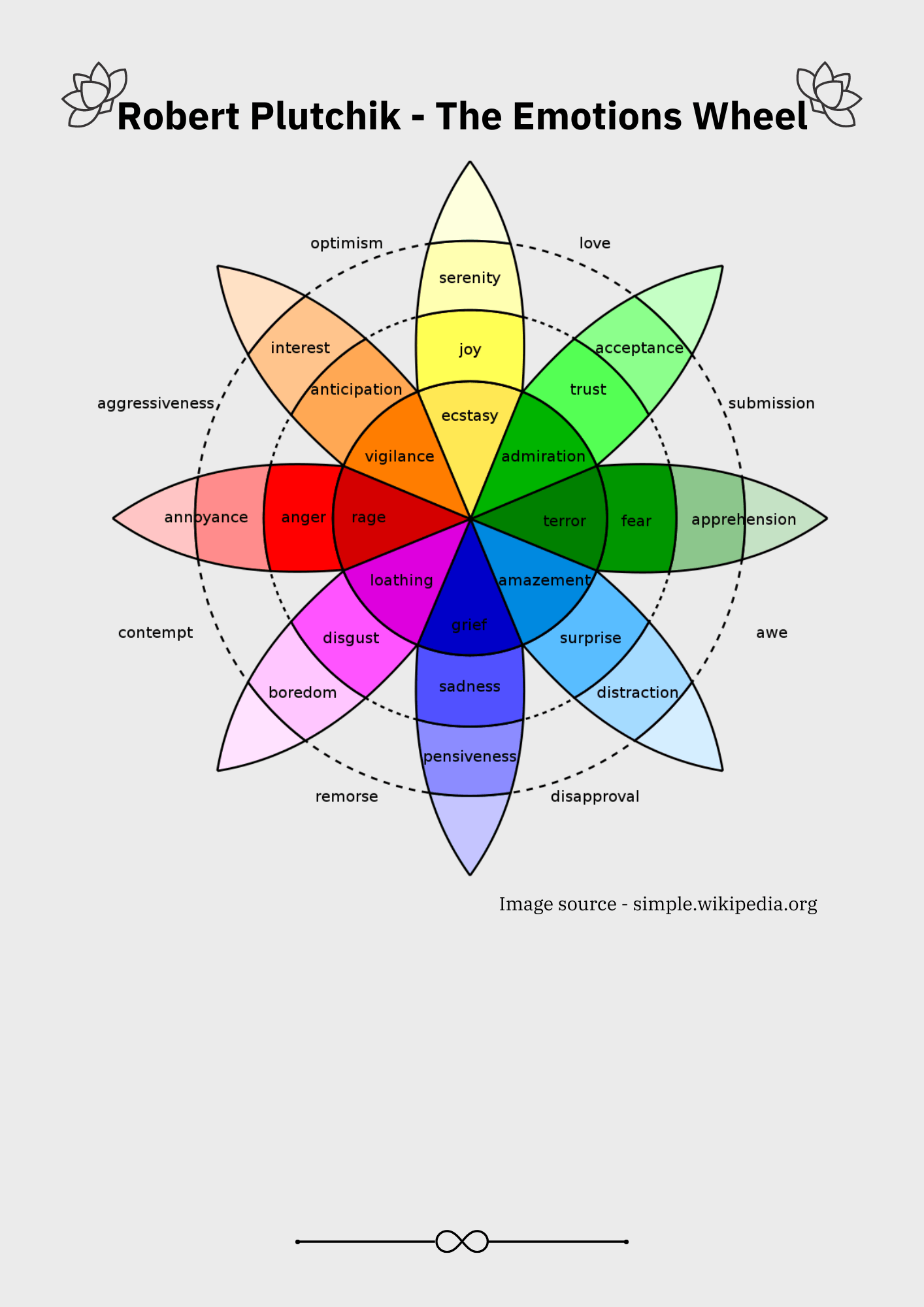
I will introduce one of many - Robert Plutchik: The Emotions Wheel. This one is also not perfect, but it can be a reference point for understanding what we are feeling.
It will help you identify and describe the 8 core emotions; joy, trust, fear, surprise, sadness, disgust, anger, anticipation. It's part of his psycho-evolutionary theory of emotion. It expands previous theories which labeled 6 or fewer primary emotions.
It's interesting as this wheel (look at the graphic below) shows the polar opposite: anger-fear, anticipation-amazement, joy-grief, trust-disgust.
It can also give some clues when being in between two different emotions:
joy + trust = love, trust + fear = submission, fear + surprise = awe, surprise + sadness = disapproval, sadness + disgust = remorse, disgust + anger = contempt, anger + anticipation = aggressiveness, anticipation + joy = optimism
It also depict degrees, spectrum, an intensity of emotion: admiration - TRUST - acceptance, terror - FEAR - apprehension, amazement - SURPRISE - distraction, grief - SADNESS - pensiveness, loathing - DISGUST - boredom, rage - ANGER - annoyance, vigilance - ANTICIPATION - interest, ecstasy - JOY - serenity.
Emotions Wheel was not only created to explore and identify emotions, but was used in further studies about basics survival mechanisms and not only.
For example, when you encounter a threat (wild lion) - stimulus event - you will most likely respond as a danger with fear which will range in intensity. That's all in order to escape and try to survive. That engages our fight or flight mode, and we either fight the threat of flee from the situation.
That can tell us that every emotion is there for a reason and can be tracked down to basics survival mechanisms which kept us alive. Now in a modern world, we encounter different dangers like getting fired from the work, or failing driver's license tests, and still, our mind recognizes them and uses the same defence mechanisms.
When we will be able to recognize our emotions with a pinch of mindfulness, we will be able to become better at assessing our own behaviours.
I covered only a brief introduction to psycho-evolutionary theory, as that's what we needed for this online course purpose. There are still more details to learn.
Emotional Inteligence
Emotional Intelligence known as Emotional Quotient (EQ) is the ability to understand, use and manage emotions in positive ways to manage stress, communicate effectively, emphasize with others, overcome challenges and defuse conflict.
Emotional Intelligence is important to build strong relationships, succeed in a career, achieve personal goals, connect with your feelings, make meaningful decisions.
It is something you can acquire and learn.
"Emotional intelligence is commonly defined by four attributes:
Self-management – You’re able to control impulsive feelings and behaviors, manage your emotions in healthy ways, take initiative, follow through on commitments, and adapt to changing circumstances.
Self-awareness – You recognize your own emotions and how they affect your thoughts and behavior. You know your strengths and weaknesses and have self-confidence.
Social awareness – You have empathy. You can understand the emotions, needs, and concerns of other people, pick up on emotional cues, feel comfortable socially, and recognize the power dynamics in a group or organization.
Relationship management – You know how to develop and maintain good relationships, communicate clearly, inspire and influence others, work well in a team, and manage conflicts."
There isn't any way around (or at least I don't know it) to develop EQ. Generally, it's about becoming more aware of inner movements in the present moment and acting on them in a positive, constructive way. Meditation, putting your attention inward (into observer mode) during everyday scenarios will help you become neutral and to respond consciously. Emotions, feelings will be just like clouds in the sky, flowing effortlessly... Seeing all of the energy in motion with a choice to react or simply to observe.
Fight-Flight-Freeze Response
Fight-flight-freeze (FFF) is a self-protective mechanism to help to survive. It's designed to mobilise the brain and body to fight an enemy, run from a car running in your direction, or freeze to hide from predators. It's interesting as FFF is acts quicker than a rational mind.
Our brain can often misinterpret situations as dangerous and set off this response, or we respond in an undesirable way.
Most of us live in a relatively safe environment, the stress we experience is more mental or emotional.
What triggers FFF in modern times for example:
You have been called to your boss's office.
You are about to give a public speech.
You are running late for a vital meeting.
You are constantly worried about a bad economy.
You are overstimulated with information noise.
It all begins in the amygdala releasing a reaction that causes physical effects. Generally, all those parts which can help you survive to get additional energy and focus boost. These include:
Rapid, shallow breathing;
Heart rate, blood pressure increased;
Blood diverted towards major muscle groups;
Food digestion is slowed;
Dry mouth;
Palling and/or flushing;
Tunnel vision and loss of peripheral vision;
Shaking;
The immune system is affected;
Relaxation of the bladder;
Nausea and 'butterflies in the stomach';
Additionally, when FFF has activated it causes the brain to scan through negative memories, probably in a search to find solutions and avoid negative outcomes.
If we are being mindful of this mechanism we can use it to our advantage, unlocking super abilities simultaneously having a clear mind and judgment. Once the perceived threat has passed, the hormone level should return to normal. But when stressors are always present, you feel constantly under attack, FFF stays turned on.
Long-term exposure might increase the risk of many health and mental problems.
That's why It's crucial however to always turn off this self-protective reaction if there's no real threat.
Constant stress, anxiety, depression are some of the factors which create a loop. That influences the ability to slow or cancel FFF activations.
There are ways to turn off a flight-fight-freeze response loop:
Slow down and deepen your breath. You can breathe fully like in Myspiritway Breath - belly, middle of the chest, upper parts of the chest, but do it extra slow. Fully exhale and fully inhale and then hold for a couple of seconds.
Contract your body slowly with each inhalation - hold and on the exhale, slowly progressively relax your muscles.
Move freely to mindfulness, into a meditative state of mind. Get into observer mode. Create distance between the feelings, thoughts, physical sensations. Stay mindful.
Consider tai-chi or chi-gong practice in your everyday routine.
Generally, a healthy everyday routine that includes a lot of rest, a balanced diet, mindfulness practice. It is important to facilitate an environment that is in favour of calming the system down, and doesn't let it overheat.
Emotions and Biological Responses
Every emotion can be determined by sensations in our bodies. Whenever you experience intensive emotions, switch your attention to the body. Realize what are the expressions of these vibrations.
Even by simply observing your body, you would create a distance. Emotions start to fade away. Simply they do not have the power (as we don't feed them) to control the system. Connect it with deep, slow, controlled breath. Sometimes it requires more, sometimes less time. Make a habit out of the controlled conscious responses.
Treat it as a skill, the more you practice, the better you get at it.
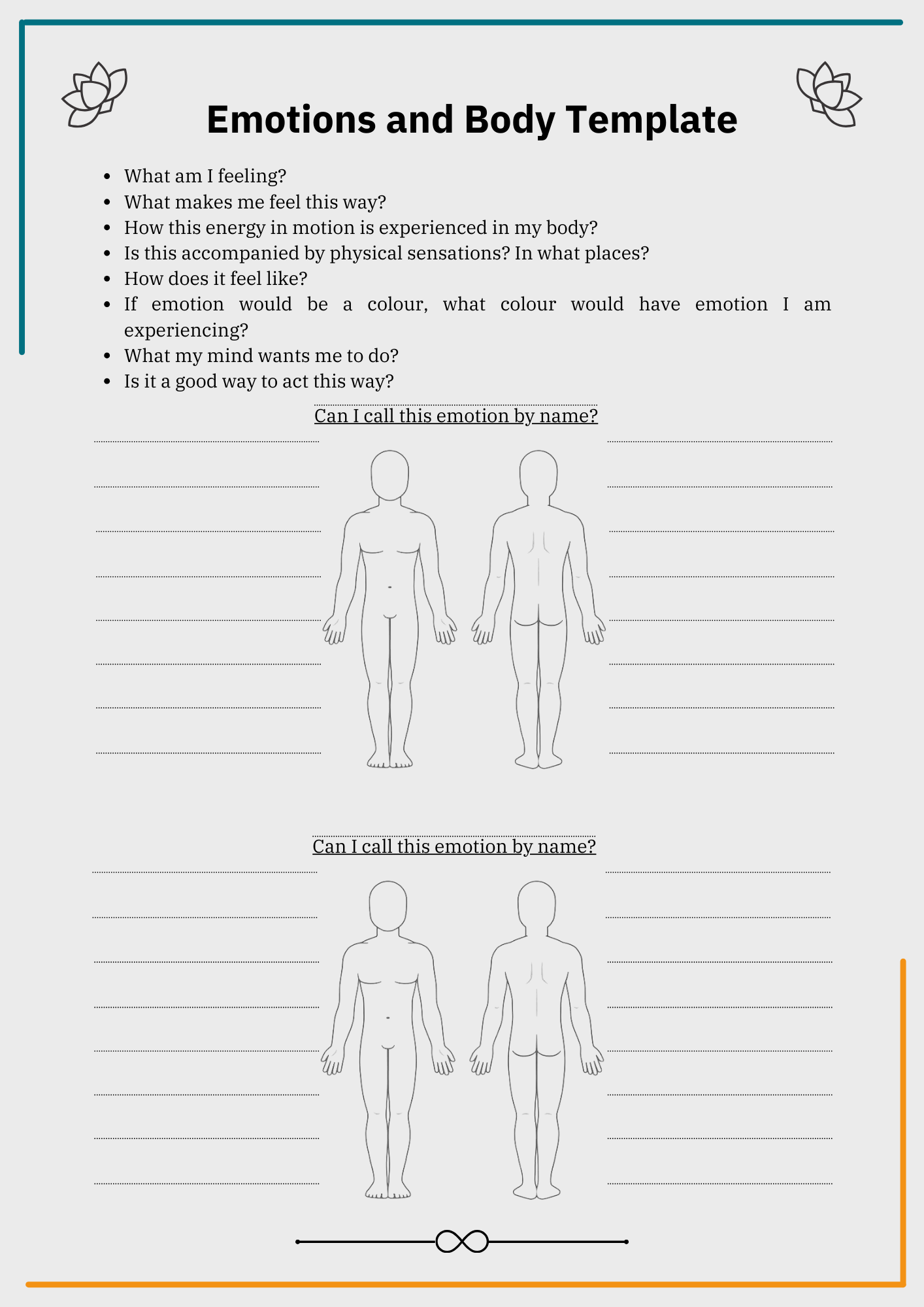
On the next page, I attached a template so you can connect the emotion with a place on your body. Use the support questions and master observer mode.
Bodily topography of basic (Upper) and nonbasic (Lower) emotions associated with words. The body maps show regions whose activation increased (warm colours) or decreased (cool colours) when feeling each emotion. (P < 0.05 FDR corrected; t > 1.94). The colour bar indicates the t-statistic range. (source pnas.org)
Social Awareness
When you will be able to recognize and understand the processes within you, that also includes you talking and showing your real emotions. It will be much easier and even natural for you, with a bit of empathy, to understand how others might feel.
In the next month, I will talk more about nonverbal communication. That will give you even more understanding of what others might feel. That will help to act with more compassion and empathy towards others. It was one of the topics which interested me deeply once I was a teenager. Before the next month's coming, watch the Lie to Me series, it is focused on decoding micro-expressions and body language.
Don't remember, if I mentioned it, but it's possible to feel into other beings. It's interesting, I call it well-developed empathy. Try it yourself. When you will be communicating with another person, mentally create energetic strings between your chakras. And try to feel into another person, simultaneously feeling your own body. You can reflect other people's emotions on your own body!
I want to expand the emotional social awareness and mention that scientific researches mention that animals also have feelings. Many of the feelings we experience animals also experience. Neurochemistry is the same. Hope that will awaken some inner respect towards our smaller folks.
Coping with emotions (at the moment)
There are emotions in which are worth being in control, one of them is anger. I am not suggesting to deny or repress such an emotion, since it is flowing through you, as this has other negative consequences. It's more about experiencing it internally without causing harm externally.
When you will not feed your automatic responses, but instead get into an observer mode, with time you won't react with anger, fear, sorrow for stimuli as you used to do. You will become reasonable, neutral, and calm within.
You already know that being under strong emotions is an advisor for poor choices and can have a severe negative effects on your life.
If anger is in control, there can be caused a lot of harm, lose track of logic, poor communication, bad decisions. Even if there is a "good" reason for being angry, it's most likely you will end up doing something which you might regret later.
There are many ways to gain control over emotions. One of the ways is to stop the power source of emotion for a moment:
Pause for a few seconds.
You can remove yourself from the situation. Leave the room or look away. If a trigger is a person, you can use an excuse like the need to go to the bathroom.
Repeat within. "I accept that I feel XYZ".
Consciously look at why do you feel this way. Remember to pay attention to yourself, not on pushing the guilt over the others. "What is within me that makes me feel this way?"
Take a deep relaxing breath. - Ujjayi. Calm down the chaos with slow, relaxing breathing instead of shallow, fasten, irregular. That will help you get into observer mode.
Think carefully about what you are going to do or say. Be logical and rational. What is the most rational way to act upon it? Focus your mind on finding a solution.
If emotion is a fear that can help you out to grow as a person. Example "I am so afraid that I will fail, that I don't even dare to try", "I am worried that something bad will happen to me, that's why I decide not to travel abroad", "I feel that it will make me more believe in myself, if I would perform my song on the street, but what if others won't like it?".
The natural reaction is to stay away from the source. You might want to confront fear, as often avoiding make intensify this feeling.
Be rational and think logically. Can it actually harm me? What is the worst thing that can possibly happen, if the scenario would materialize itself? How can I prepare to encounter it?
It's important to take care of high levels of energy and learn to deal with stress.
When you are journaling either in your notebook, or on Myspiritway Forum, pay more attention to the feelings that accompanied you during the day.
Important to remember. The way we behave in each situation will confirm - strengthen, or deny - weaken (simultaneously creating a new one) current emotional circuit. That's important as it suggests that you can concisely alternate automatic responses!
When you look for any cause of why you might feel a certain way, it's wise to start from your body - purely physical cause. Sleep quality, hunger, dehydration.
Learn to Discharge
Not every emotion we carry is fully acknowledged or understood. We tend to numb our senses, look for distractions just to not let challenging emotions be processed and dealt with. Instead of looking to solve, or find the cause of your emotions you simply avoid confrontation.
Gaming, drinking alcohol, taking drugs (that include weed), watching series, eating, filling the calendar with "important" things to do are quite common coping mechanisms to push emotions under the carpet.
After some time, when you finally don't have a choice feelings are worse than before, because you gave them time to grow within you.
Another mechanism that might suggest you are suppressing your emotions is that while you are quite calm through the day, one unsubstantial event can cause you to explode. The energy then finds temporary leakage.
Another sign might be that you feel uncomfortable with highly emotional people who visibly express their emotions while you are avoiding it. Simply, because subconsciously you know that they remind you that there is something that needs to be healed.
Excess (overstimulation) of emotions can lead to mental illness. It both includes those which you are aware of and not. It drives mood disorders like depression and fuels most psychological problems - anxiety, obsessiveness, trauma, phobias, drug, and alcohol abuse.
Do I notice any recent changes in my behavior and feelings?
Do I recognize any of those patterns in me?
Are there any emotions I am suppressing or I have suppressed recently?
What are my distractors which I use to avoid direct confrontation with emotions?
That's why it's important to learn to restart the system and discharge accumulation in a safe healthy environment. Discharging is different from being mindful of the energetic flow. Emotions are physically embodied and accumulate over time (in the body). That's why we can release this tension and restore the natural flow of prana.
MySpirtWay Breath - this process which I hope you practice from day one of starting this course helps a lot to discharge emotionally. When many techniques let you only release things visible on the surface, this process is practiced regularly to unlock invisible layers which can be purified.
Dance - it can help you both to learn to express emotions and discharge. "Dance is essentially emotion in motion." There are many different styles of dance that might help you. Look for Biodanza, Trance Dance, Ecstatic Dance, Spontaneous dance, Dance Therapy, and many others.
Mourn. It's okay... Everyone has the right to discharge this one, no matter who you think you are, or you are not. It's important to allow yourself and accept it. Crying is cleansing. You will feel much better, instead of keeping things inside, let them be washed with the help of tears. After mourning, consider having a nap and spending the rest of the day on relaxing activities.
Go wild! In a safe place where you can be free from any judgment, let yourself release the breaks. Scream, make the wildest sounds you can possibly make, howl like a wolf. Stamp with your feet like an annoyed baby. Hit in the pillow. Let go of everything, whatever needs to be released.
Visit Rage room. Imagine a room full of the wreck, you wearing protective clothes, equipped with a variety of different hammers. You can completely let go, and release a lot of accumulated tension.
Write down all your feelings and burn the page. Connect it with the inner feeling of understanding, accepting, and letting it go.
Emotional numbness..?
Feeling empty... Nothing seem to bring you joy?
Emotional numbness is when you lose the ability to feel or/and express your emotions. You might not even realize this as something negative. Unfortunately, numbness can grow and increase with time.
Signs that you might experience emotional numbness:
You have lost interest in your daily life. It includes all the aspects of life such as health, job, relatives.
You are not able to feel pleasure. All of those activities which have delivered a lot of joy and fun don't touch you anymore, and they feel pointless. It also includes experiencing a lack of enjoyment from food taste.
You feel emotional and physical fatigue.
You have a lack of motivation to do anything. Before anticipation was bringing this nice feeling now leaving you in bad mood.
You are really indecisive. Lack of confidence in your own judgment.
You feel guilty for everything. Even if it comes to rest, taking few days off - this feeling of guilt is slowly taking control over you.
You want to alienate yourself from others. It's difficult to connect with anyone, you simply don't feel anything.
You feel like there is no solution nor hope for the numbness to end.
Emotional numbness can be caused by:
Depression and anxiety - one of the most common causes.
Overwhelming stress or nervousness.
Some medications.
Post-traumatic stress disorder.
Mental, emotional, physical, substance abuse.
(there are more causes)
It is possible to treat emotional numbness.
Look for professional care, as often you might feel hopeless.
The psychiatrist should help you to identify an underlying cause, once found out can help to direct the treatment and look for other alternatives.
It's good to do the complete opposite, and reach out to your trusted beloved ones and express all of this process and ask them for support.
Incorporate a lot of movement - exercise daily.
Get plenty of rest.
Reduce stressors in everyday life and learn stress management techniques.
Eat well, keep balanced healthy diet.
Summary
Beyond all of the theoretical knowledge introduced in today's topic is all about the practical part of building Emotional Intelligence - every day.
When you will build up consciousness about emotions and feelings, you will be able to look with greater wisdom on people who cause self-harm, bully others, overuse substances. That will let you find compassion towards others instead of judging them as you don't even realize the core of their behaviour. You won't be triggered any more by other people's actions and circumstances, instead you will be full of compassion and love.
It would be challenging and time-consuming to learn all the possible feelings, emotions, and bodily reactions by heart. That's also not so practical and effective if it comes to becoming more aware of those processes occurring within.
Additionally, different people can use terms to name different things.
That's why I would like to encourage you to be more aware and describing your own feelings using the template, and putting additional awareness during the journaling process. Thought the processes identify the source of difficult emotions.
During previous months we went through other ways which take part in healing inner emotional wounds and simply bring up more positivity to life. Keep on practicing, as you know which one of them brings most of the effect.
BTW. Watch "Inside Out". ;)

MySpiritWay Practical Spirituality. We can help you; create a supportive lifestyle,accelerate spiritual and personal growth, reduce life suffering, raise your consciousness, and achieve life satisfaction across all fields.
Simplified Practical Spirituality
Everything you need to know about practical spirituality and the evolution of consciousness.
Get Access here
MySpiritWay © www.myspiritway.org