#29 - Extra Productivity
Introduction
We all have the same amount of time - 24 h, 1440 minutes, 86400 seconds. Every moment is a given moment, call it a gift. It is all up to us if we decide to waste this gift or invest it to grow beautiful things. Finding better ways to become more efficient/productive every day, minimise the time wasted on something that won’t make a change in your pursuit of achieving your life goals.
Since everybody has the exact same amount of time every day. Have you ever wondered why some people manage to get so much done in a day while others barely manage to complete basic tasks?
It's about effective time management and maximising productivity.
Managing time makes you more efficient, productive, free of stress, purposeful, and focused on your goals.
You already fixed your sleeping routine, therefore you know that one of the best ways to get things done is - by waking up early in the morning. You already know that falling asleep at regular times is more effective in the long run than staying awake in the late hours.
You also know the Pareto rule. Apply it to productivity and time management. Identify 20% of tasks that contribute to 80% of your results.
This week we will build consciousness about our usage of the time, and how to get the most out of it.
Procrastination
Simply said, it's about the act of delaying or postponing a task or set of tasks. Procrastination is the state of mind which is connected to low energy, as a result you suffer - lack of motivation. Often caused by mind programs or, simply by accumulated stress. When you will take care of healthy habits, you will become full of energy almost all the time.
There are indeed plenty of tricky mind programs which stop our free flow of creative energy. Our goal is to recognise negative mind programs, so we are able to consciously decode them.
Programs that can cause procrastination:
Putting too much pressure. "My whole life or career depends on this one single task.'' This might lead to an excuse mind that looks for reasons to delay any action.
Excessive perfectionism. If you cannot do the task perfectly it doesn't mean that you shouldn't do it. The best way is to start with currently available resources.
Recognise your perception of tasks. Instead of ''having to do something'', go for "I have chosen to do it". It will let you pick those things which you truly enjoy.
If something is a "must-do", often is just better to get it done, and let the energy flow.
If we don't fully understand where to begin or what to do, we often look for distractions. Break down tasks into smaller manageable tasks, and start doing it.
Set periodic reminders. It will give you a kick to engage in the activity.
For some people penalties or rewards work well. Maybe it will work for you too. I think it's much more beneficial to focus on raising energy levels, so it will allow you to be in a "flow" state when needed.
Don't get into the trap of "being in the mood". You don't have to be in the "mood" to take an action.
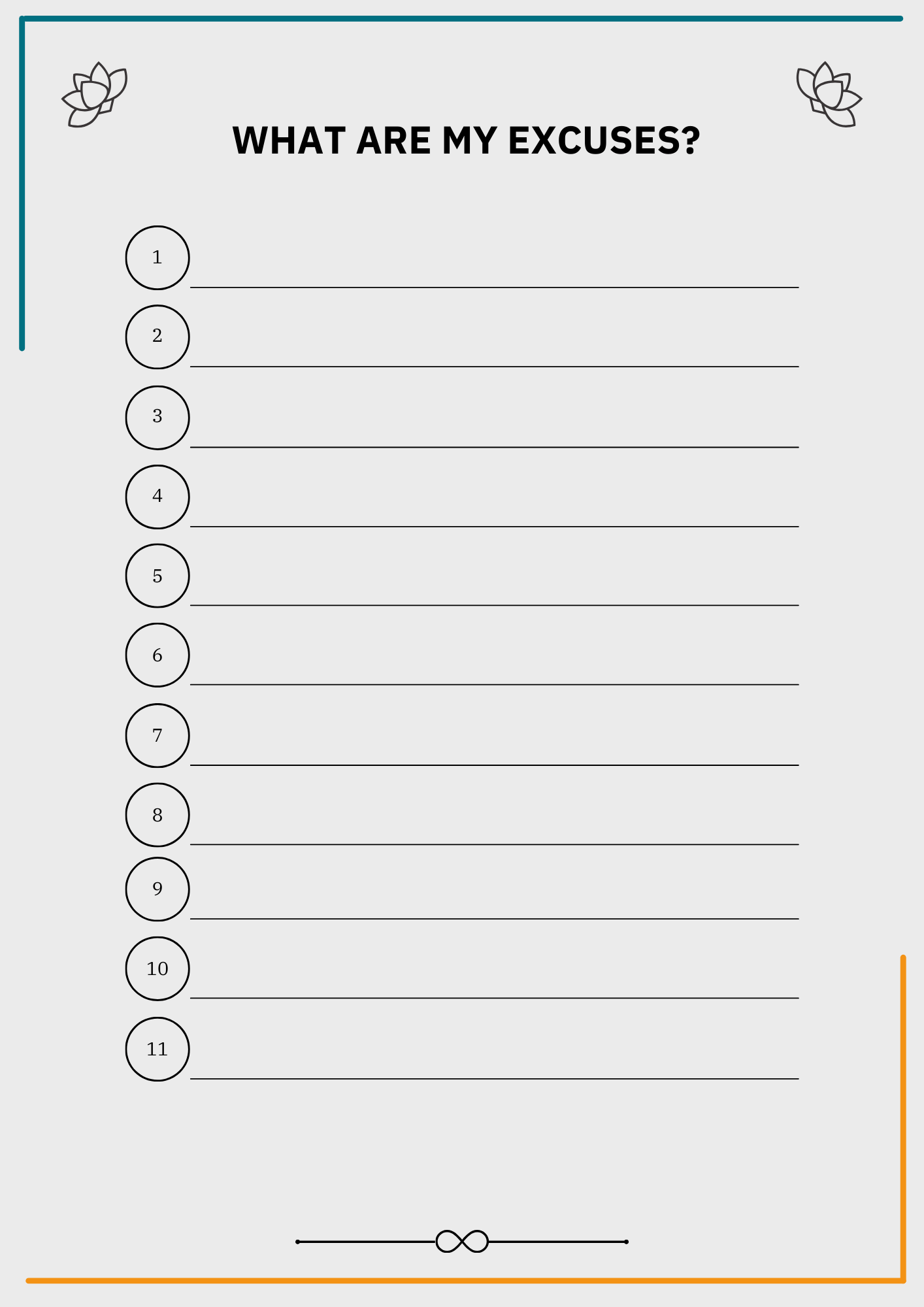
Make a list of your excuses that keep you on hold. Thanks to the recognition you will be able to work on changing your behaviour each time when the program will be activated. You can use the template on the next page.
Learn to say NO
You are the boss of your own day. You have complete control over what you want to do during this day or don't want. You have the right to refuse activities that don't fit your goals or have low priority for you. Either it is your friend, family member - your tasks and your routine is the most important thing in the world.
Learn to be assertive and in a polite way explain why something is important for you and why you can't change your plans.
You are not rude or inconsiderate. You are the powerful individual who clearly defines priorities, and knows what they want.
How often did you do something against your inner acceptance? How does it feel?
Everything has some cost included. If you decide to help your friend to move out of the apartment over the weekend. You won't be able to relax after a long work week, so it might affect your well-being. If you feel like, help your friend to find an alternative or middle ground, let say to help him on another day where you will actually be able to.
I am not saying to don't help others or take time out for them. It means don't let people take advantage of you to lock your time into their tasks when you have priority tasks to finish. Anything that doesn't make you productive might not be worth your time and effort.
Know your value. Be decisive. Don't take much time if it comes to responding to a request you don't want to fulfil. Learn to create visible borders. The answer should be simple, direct, clear, and firm.
It's also good to give people a clear reason, why you act in a particular manner. Simply "why" will make it easier for them to digest. Always be honest, even if people don't like it. Don't postpone the answer, and make sure to give others enough time to find some alternative.
Utilise phrases such as "thanks for asking me to help you, but I won't able to assist you as my schedule is already filled with 'important for me' tasks". Make sure your body language is assertive and strong. Don't look guilty or be over-apologetic.
Remember you refused a favour, not a person. No need to feel bad inside. Be aware of manipulative methods which some people induce. If somebody doesn't understand it or doesn't even try. Do you really want to have people like this around you?
Depending on what people you are surrounded with. Some of you will be surprised by how many time-lechers we have around us. We want to surround ourselves with relationships that are based on mutual understanding and respect. Become powerful and let yourself let go of some people to make space for new.
Body language
Did you know that it is actually possible to read other people's minds? Body position affects our state of mind, our perception. Often automatically on our face (micro-expressions) or our body adjust its position to emotional responses.
You can either know what others are thinking, or you can trick your mind to actually alter what you want to feel, or even on how to change the perception about yourself in others' eyes.
Not only body position matters but also what you wear; how well your body is taken care of. So if you want to feel serious, confident, focused, dress - behave - purposely alter your body position.
Look at the photos below, what in your opinion, those people are feeling?
Try to take a different body position, stay for some minutes in it and observe how your perception changes.
Learn to prioritize daily tasks
Even a basic schedule can help you to productively end the day. After the Chinese Organ Body Clock, you already know to do the most demanding tasks in the morning, in the energy peak.
Make a list of the tasks that you want to complete by the end of the next day. The best time to plan your next day is in the evening, as a grounding activity. It will help you fall asleep without disturbing thoughts.
Be realistic, rather than planning too much. Make sure to add relaxation into your schedule, to really stay effective.
Rate each task's importance accordingly: (or create your own rating)
Can be done right away.
Vital - Urgent
Important
Important, but not time-bounded
Unimportant
Remember to assign an estimated time for each task, and actually track it. It's best to use the calendar feature on your phone. Connect it to cloud service, so in case of losing your device, you can still have an access anywhere.
Plan to do your Most Important Tasks (MIT) first. Pick your MIT and focus on it, so you don't waste your energy on tasks with low importance. Following the Pareto rule, 20% of your (MIT) will give you 80% of the results. That's the key to feel productive. Remember to schedule breaks.
If you have two big tasks, start from the bigger one, the toughest first. Once you complete it, you will get a strong sense of accomplishment and it will motivate you to push even further.
How often do you start something, but you don't finish it?
One of the most important life-changing habits you can have is to learn to complete things. Observe it even in the smallest and less important things.
Books, which wait for you to finish the last chapter?
Last round at the gym? Or last 5 min of running?
Ask yourself, "what stopped me from completing that task?"
If you don't learn to complete small things, you will never be able to successfully get a big project done! It's interesting as this approach forces you to pick things that you really want to do, and you know that you will have the willpower to do.
How committed are you?
If getting started is the hardest part for you, then decide to start with a smaller, less demanding goal and commit to it. With time you will create enough inner strength to commit to more challenging projects. Our mind often wants to experience instant gratification, so we tend to avoid unpleasant, hard, or repetitive jobs. As a result, we might find ourselves wandering around, that's when we reach for unproductive activities like checking newsfeed, messaging friends.
Observe yourself, find patterns where your mind leads you.
Decide if you want to change it.
If yes, start doing things differently than you used to.
Repeat long enough to break the mind program.
That's why Kaizen is pretty handy in this scenario. Committing to the small goal is based on reduced mental resistance.
For example, focusing in blocks of time on one activity, and prolonging focus with time might help you. Set up a timer and maximise focus in the chosen block of time, then go for a break.
If it comes to breaks, it's not about pointlessly browsing social media, or chatting with friends. It's time to do absolute nothing. Observe your energy levels when you apply to this rule and when not.
Most likely, if you decide to do it other way, you won't be able to provide enough rest. You can find out that your brain doesn't get enough break time and in each block is harder for you to focus because it hasn't regenerate, or rested.
BTW. If you REALLY REALLY want to do something, you will do it. There won't be any space for excuses. If your will is not strong enough ,you will find yourself looking for distractions. Always look at reasons why you want something. Simple as it is.
Sprints
Pomodoro - most well-known technique. It involves working for 25 minutes and taking 5 minutes breaks. You need to find the perfect time for you as twenty-five minutes might not work for everybody.
If you complete 4-5 cycles, take a longer break 15-30 min - to regenerate.
If somebody wants to disturb your cycle, for example by phone call.
Simply tell them: "I am busy, can't talk right now, I will call you back in x minutes"
As you already know, mind likes to keep things in order. That's why pomodoro is effective. You are single-minded focused on completing one task at a time.
It will help you get out of the unhealthy habit of simultaneously doing many other mindless things. So you will be able to develop a sense of urgency and focus.
To master this technique you will need to create a habit of working like this.
If you decide on this technique - be deliberate about it, and stick to it!
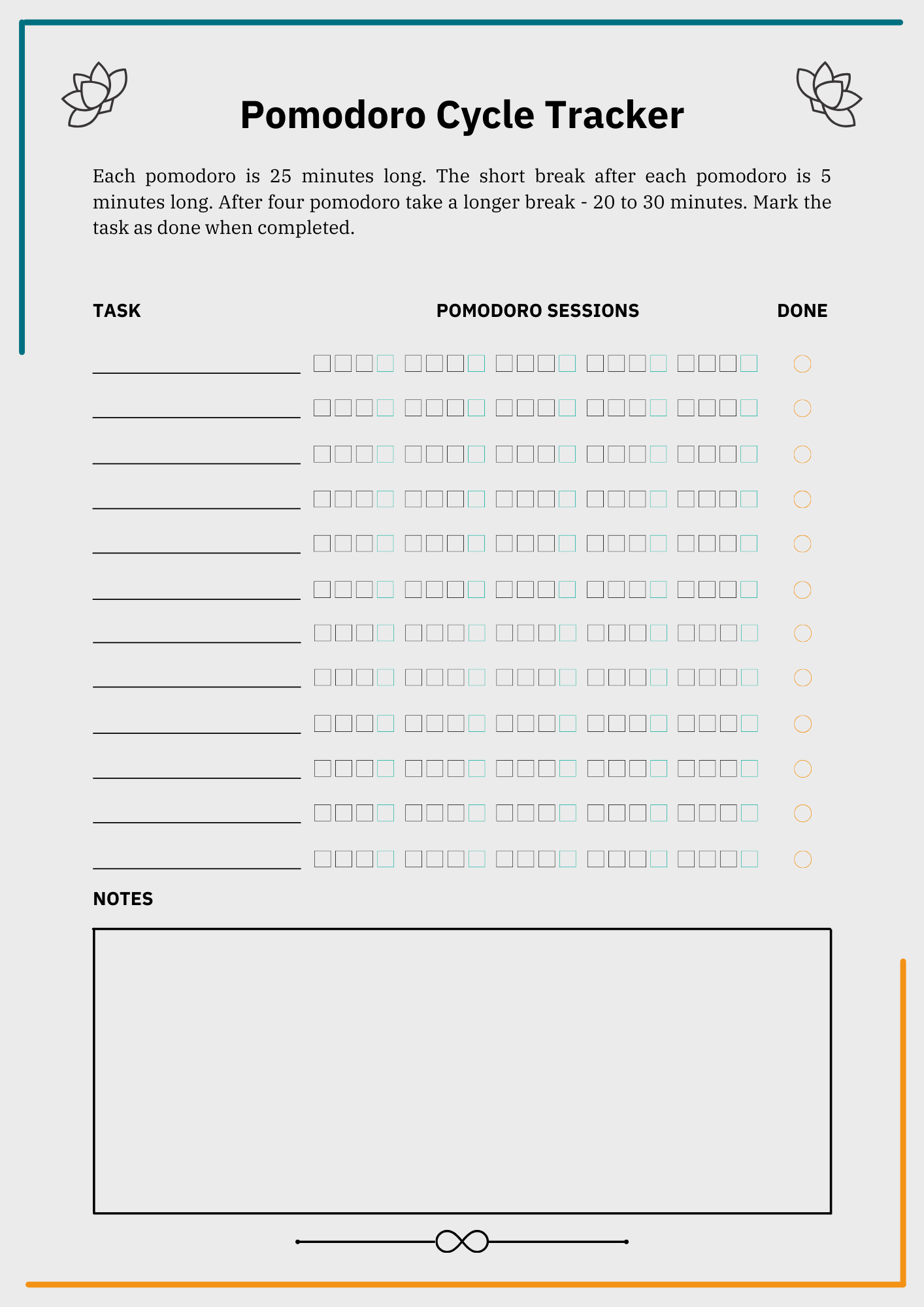
You can consider some pomodoro cycles trackers. There are apps available, or simply use the timer, and use the template on the next page.
How to do it:
Set the timer for 25 minutes which is for you to focus on the task. Within these 25 minutes you’re not allowed to answer your phone, text, let your thoughts wander around, or get bored from what you’re doing. Just think about what you are working on, look at what’s in front of you and focus.
When the timer signals. You completed a single session. You can not come back to your task. Be strict about this rule!
Set another timer for 5 minutes within which you will lay down, sing, listen or eat - basically do everything that makes you relax. Try to stay away from social media news feed which would make you lose a track of time, later discouraging you to get back to work. Meditation is a habit worth consideration. Daydream or draw, play an instrument. Something that is not mentally demanding (if you are working using your mind) or psychically demanding (if your job require physical activity).
As soon as you hear the ending signal from your timer, fully engage in tasks again.
Go ahead and try this out, or create your own proportions of time that you’re going to spend on your daily routine. Discover what is your limit of constant focus, and take 80% of that time. It might vary in different tasks, so be smart about it. That's your output for pomodoro.
Break tasks into menagable steps
If a task seems overwhelming and you don't know where to start. Try to break it into smaller pieces. It will help you decrease the chance of procrastination and the creation of unnecessary stress. It will cost very little time, but it will help you to be productive.
Make a list of steps for every project that you are going to take. If it's a very big project, then there is no way to accomplish something without dividing it, as you will need to distribute smaller tasks over days.
For each task on your schedule, make your own way to break it down into small steps.
For example:
Title, what is it that you are about to do.
Ask yourself what has to be done to make the task completed.
Write them all down.
Put them all in a proper order.
Set up smaller deadlines. You will finish it in x amount of time.
Start working on it.
Breaking a task into specific steps will bring clearance to your mind, and will be easier to do what needs to be done, and schedule it accordingly.
Use a mindmap software. Its simplicity and clear form will help you with organising your tasks.
Remove distractions
Either you want to relax, meditate or have important deadlines met, it might be sometimes difficult to stay focused for a long time.
Social media and all its information noise made a great work to drastically shorten human attention span. Concentration is a skill that can either decrease or improve with age and lifestyle. It's crucial to any task completion, that's why it's important to practice it. (There will be special exercises focused on developing a concentration in future months when we will talk more about meditation and concentration techniques).
For many, it's impossible to ignore an email, incoming phone notifications, social media dopamine injections.
Or maybe you have some 'distracting roommate'?
Do a reality check:
What is my priority?
Can this wait?
Is it crucial for this moment?
Can I do it later?
Steps worth taking:
Create consciousnesses of tracking time killers. (There are also some trackers software and APPs to assist you) Make time for those "important" things after your work shift.
You can plan your time during the day for checking notifications, email, or gaming. That's one of the most effective ways to deal with it. You dedicate time to certain activities, and you can't do anything else. Always immerse fully into what you do.
Turn off unimportant notifications on your phone and your computer. Turn on a special 'do not disturb' mode.
Add special extensions blocking temptations on your computer. Consider uninstalling social media, games, and other distractors from your devices.
Simply close the email box, and other distractors before starting a new work session.
Remove all gadgets from your workroom or desk if possible.
Minimalise your workspace
We will talk about the minimalistic approach to life next month. There are a couple of tips that are connected to it.
One of the elements which helps to stay focused is to minimalise external/material chaos.
Remove everything. It's best to start from the truly clean workspace.
Clean everything out of dirt and dust.
Find your own system. You are creative enough to come up with your own ideas to create a place where you can really engage in work.
Clear your desktop. Delete unnecessary files, organise the rest in folders.
Uninstall unused applications - especially if something takes only a few minutes to reinstall. Both on the computer and your phone. Clear downloaded files, run the program for removing unnecessary files.
Evaluate items you have around. Ask yourself: "Do I really need it? Does it serve its purpose?"
Start putting your items in their respective places. The best way to keep things in order is to stop making the mess in the first place.
Declutter your desk and your room - less is there, less chance to disturb your motivation. Clear all paperwork with the exception of what you need that day. Put everything else into physical folders, file boxes, and drawers.
The end of work should equal clean your desk, so it will be ready for tomorrow.
Express yourself, make yourself like at home.
Music to improve focus
Calming music, ambient nature sound, or simple white noise like fan or babbling of conversation in a coffee shop may help you to stay focused on your tasks.
Low volume noise has been shown to improve creativity and focus for many.
Find what do you enjoy the most, or maybe a total silence is your thing? Experiment and find your way.
Nature sounds
Binaural beats
Classical music
Ambient
Instrumental
Generally, melodies/music without lyrics works the best.
Create an association with certain music or playlist. When you are in a certain emotional state of mind, for example motivated and focused - play chosen music. Or when you are performing a certain activity, for example, you are programming - play background music. Your brain will associate it with "doing" or any other state of mind which occurs during sessions.
After repetition, it will create a strong emotional association which will be needed when you will feel at your weakest. Play it each time when you deal with difficulties.
Two-minute rule
We tend to put off unpleasant tasks on the side, even if they take only a few minutes to complete. Funny how energy save mode works. It might lead to stacking up many different tasks and creating unnecessary stress due to coming deadlines. Look for efficiency in every situation.
Here's a basic example: it's more efficient and less unpleasant to wash dishes straight after eating, than having a sink full of dirty plates to clean at the end of the day.
If something takes 2 minutes or less - deal with it immediately. If you create a habit out of it, you will be surprised how well your life will improve.
Right people
The most important tool for living a better life is to surround yourself with the right people.
The people we surround ourselves with are the biggest influence on our behaviour, attitudes, and results. It sets the course of your life.
In the words of motivational speaker Jim Rohn:
“You are the average of the five people you spend the most time with.”
The people you spend the most time with shape who you are. They determine what conversations dominate your attention. They affect to which attitudes and behaviours you are regularly exposed. Eventually, you start to think as they think and behave as they behave.
If you want a high-level performance, then surround yourself with people who perform on that level. The mirror neurones will model behaviour those people have, as a result of it, it will be easier for you to acquire skills they have.
Be creative, ask yourself:
What do I want to master?
Where people who already mastered, or are working on it might spend their time?
Consider applying for courses, seminars, public events.
Ideas notepad
There is a saying that everybody in life gets at least one life-changing idea. Our brains are good at processing information but are not great at remembering.
Create one of the millionaires' habits and always carry a notepad (or a digital version) with you.
It will also free up the busy mind, which always wants to process some data. So it will help you to get back to your current focus.
Either the idea is connected to the current project you are working on, or it's just some wandering one - write it down!
Learn to be organised and create separated notes for different thoughts. It will be much more pleasant to go through them later on.
If you decide on digital notepads, consider those ones which you can have on many devices simultaneously, it helps to always have everything under the press of your fingers.
To-do list?
One of the surprisingly simple solutions to become more productive is to have a checklist. It’s about dividing a process into smaller particles and resolving them by following a to-do list. It releases the mind from having to constantly remember. It's like shutting some process, to loosen some RAM memory. It helps to release stress and let focus on the process.
You can actually make a checklist for everything! Basically, if you plan to do something it would help you to fully concentrate on that.
Checklist for everyday routine.
For big projects which you currently work on.
Having a checklist, especially for less frequent tasks like once-a-month travel will save a lot of time, and makes sure you would never forget anything.
It works pretty well with groceries too.
Checklists are also good for people who do things habitually due to mastery of some process, you won't forget any step you need to take.
It is worth doing a segmented schedule (particular period of time for each task) for the next day the day before. Also, schedule breaks; breaks are as important for your progress as any other task.
To-do-list, checklist plus calendar.
What about a schedule-based calendar? In some cases, or for some people, it might be a better solution. Realistic time limitations push you even more towards task completion. It forces you to stay focus as you know that you don't have the whole day.
While performing daily tasks, remember to reflect on them at the end of the day. It will help you in staying motivated.
Reflect on what you accomplished today.
Pinpoint what you could do better.
Promise yourself to apply conclusions for the next day.
Review your goals
You already know that a daily visualisation is a powerful tool to stay motivated and to strengthen your vision of the future. This is just a reminder for you. Review your goals regularly to always keep yourself on the right track.
It's also good to create a digital mobile version of your goals and keep them in a notepad. It might sound funny; I often review my goals while sitting on the toilet or while I am taking a shower. It's a great time for a few minutes of calm reflection.
If it comes to goals, make sure that they are "SMART."
Specific (simple, significant, sensible)
What exactly do I want to accomplish?
What are the reasons, or benefits of the goal achievement?
Who is involved?
Where is it going to happen? (location)
What is important?
Measurable (motivating, meaningful)
How do I know when I achieved the goal? (how much, how many, etc. )
How am I going to measure progress and success?
Attainable (achievable, agreed)
Is the goal truly attainable? (How?)
Do I have a sufficient capacity to accomplish my objective? (skills, financial, knowledge, abilities)
Do I have sufficient time to accomplish my objective?
What other types of resources do I need?
Relevant (realistic, reasonable, result-based)
Did I write the goal realistically?
Is it worth the time?
Is this the right time?
Does this align with other goals?
Time-based (time-sensitive, time-limited)
What is the genuine deadline for my goal?
What can I do today?
When will I undertake activities to achieve my objective?
When can I expect to see some short-term outcomes?
Learn to think long-term
When you wake up with a 100% battery (if you take care of good habits), every single decision, thought cost you energy. There are those that can boost your energy, but when the day is coming to end, there must be nothing that can keep you awake, you need to rest.
Always rest properly, so you can make sure that the battery in the long-term will stay fully charged.
Remember to incorporate rest in your life. There is a lot in having a day off, completely out of mental and physical consuming activities. If you think about vacations, like a long time to plug yourself off, it’s essential to really dedicate this time for real relaxation and rest.
The key is to accept that you can do limited things during the day, and that progress requires time and repetition.
Most importantly, look for long-term productivity, find a balance between active engagement and rest. You will do much more in long term and you will decrease the chance of burnout.
Observe yourself, what is your performance when you don't sleep at regular hours, because you want to get things done, or when you take 7 days working week. Are you really that effective then?
Stretch time to maximum
Time audits are a very effective way to track if there is some leakage. Check on how much time you spend on certain activities. Always question yourself. It will help you to eliminate wasteful pursuits that don't support your goals.
For seven days conduct a Time Audit to know where exactly you are spending your time. Use mobile apps or PC software (search for phrase Time Audit or Time Tracker) to note down how much time you spent on each activity. Take even small things into account! Like playing games for one or two minutes.
Usually, apps will summarise everything and separate things into blocks, so you will be able to see the % of your 24h day is invested in what activities.
Every evening ask yourself:
Am I satisfied with my day?
Did I really do the best of what I could?
Is there something I could have done better (more effective)?
Another things that's worth considering is layering new information while performing repetitive activities. Perfect examples are: while you are driving on the highway, in a bus, when cycling, or when working on some processing job. Usually, most people will listen to their favourite music. Instead consider listening to podcasts, interviews, listen to autobiographies - learn in meantime. It might be far from the philosophy of engaging in only one activity and fully embracing every moment. However, if your goal is to study and you always have an excuse for lack of time. Not anymore.
Speed up recordings - 1.25x - 1.75x. More information in a shorter period of time. In the beginning, it might be difficult to adapt, but after some time it will be simply too slow to listen at a "normal" speed.
Important questions:
What can I do today so it will bring me more time tomorrow? - Always multiply your time if possible.
What tasks can I eliminate?
What tasks can I automate?
Can tasks be delegated? - Kill perfectionism, nobody can do things as good as you can, but they will be able to master tasks jus as well as you! Teach them :)
Popular tips
There are others tips which are quite popular, maybe, it will work for you. I am personally, not a fan of them. It includes:
Creating accountability by telling others
For some, it might work for others opposite. Do you know any people that speak much about what they will do, but actually it ends on that? Success in many cases likes silence. Focus most of your power on actually doing it, not on talking about things that don't exist. Mind instead of making you motivated to do something will think that things already happen. If you want to use this technique properly - talk about things you do in your current moment, not about your future goals, as there is so much change in life, that you don't really know if something will happen or not. Often it's not worth speaking at all.
If it comes to your accountability partner, you can tell him about things you are about to do, not about what you are aiming for in the future.
Reward yourself for task completion
You need to be aware of this one. Generally, this idea can be effective if you decided to do something which you don't enjoy or you are forced (by any mysterious force) to work on. It's about scheduling your day so after each completed task you will get some "pleasure" or as I call it a dopamine injection.
Make sure, things you actually use as a carrot on the stick are beneficial for you - 5 minutes of yoga, 30 min of walk, 10 minutes of breathing exercises. Something that will add you energy and release the stress...
Our aim should be to discover what we Love, then Do that more, not to treat ourselves with a temporary delusion of fulfilment. If our task is connected to improving ourselves, then this approach might create a wrong association. When actually positive challenging things will be associated with something unpleasant. You will only wait when they will be over, and you might find yourself abandoning them in the long run.
Other tips
Prepare yourself before as often as possible. For example, if you have an important meeting the next day, have everything prepared the day before. It will save you stress.
Procrastinate on purpose. Schedule time for it ;)
Always assume that you can improve. "Okay, I do it that way, how can I do it better?" It's good to see what you've done and constantly think about how you could be doing it better, and questioning yourself. It’s called a growth mindset.
Become a person with deep knowledge and skills in one particular area, but also a shallower, yet still fairly substantial amount of knowledge in a broad area of other topics and disciplines. You will be more creative, and look at problems from a new perspective, and solve things in different ways. Especially important to learn from others by constantly asking questions. Additional effectivity guaranteed.
If you don't know what to do with yourself. Sit on your ass and simply do nothing. Embrace this current moment, rest. You will be surprised how fast new ideas will start flowing into your mind. Sit as long as you will be sure that, the idea which just came to your mind is 'the one'.
Whatever you are working on, consistency is the key to make it happen. When writing this course I was actively working on it, every single day. Sometimes I spend only 2-3 hours, on the other days 8-10 hours, but most importantly I am devoted to doing it. Small steps each day, are a very powerful method.
Conclusion + Exercise
If you apply the majority of the methods (hopefully all of them) into your life, you will become a very effective and goal-oriented person. You will be able to use given time to its fullest and in a long run, it will lead to self-replacement.
Make sure to go through all the processes and apply them to the daily routine.
The key is to build self-consciousness and create the importance of given time each day. Reduce waste. Be smart, know about where every moment of your life is invested. Think long-term. Don't be driven by instant gratification. Learn to say and think "No, I have something else to do".
What is that I am currently doing?
Is this something I planned to do?
Is it important? Does it support my growth?
How can I manage my day more effectively?
Be creative and learn to investigate your own ways to accomplish things.
Become respectful and grateful for the most precious gift which is given - time.
“The difference between successful people and really successful people, is that really successful people say no to almost everything.”
Billionaire Warren Buffett.
What are your ways for extra productivity? Write about this on MySpiritWay Forum.
Good luck and see you next week!

MySpiritWay Practical Spirituality. We can help you; create a supportive lifestyle,accelerate spiritual and personal growth, reduce life suffering, raise your consciousness, and achieve life satisfaction across all fields.
Simplified Practical Spirituality
Everything you need to know about practical spirituality and the evolution of consciousness.
Get Access here
MySpiritWay © www.myspiritway.org