#26 - Everyday Exercises
Introduction
Regular everyday physical exercises or practicing sport is one of the most important habits you can have. Our bodies are meant for consistent physical activity.
Regular exercise improves health and wellbeing significantly. It helps you maintain healthy body weight, muscle mass and reducing the risk of chronic diseases. Exercises can lift up your mood, boost mental health, help sleeping better and enhance sex life. Moreover can help to maintain good energy levels and much more.
There is so much to develop in our bodies. Physical activity can focus on improving for example:
Strength
Endurance
Flexibility
Mobility
Respiratory capacity
Agility, Dynamism
Balance
Whether your goal is to lose weight, get in a better shape, get healthier or any other, there are main components that a good exercise program should contain:
Warm-up
Cardio exercise
Weight training (both body or/and added weight)
Flexibility training
Cooldown
It's generally better to move more often during the day. When you spend long hours in front of a computer screen. Good to do simple stretches, change position, stand up for a moment. That's why sitting on the floor might be handy as it forces you to have more movement. You already know the "Chinese body organ activity clock", you can plan your workout time according to this or just simply do it in your energy peak moments.
In the mornings, start with some lazy stretching and breathing to prepare for a new day. During the peak of energy, go for more intensive practice. During the evening some less intense, calming, grounding exercises like evening walk.
PS. to do a really effective workout, you must feel pleasantly tired afterward, aim for pushing current limits, sweat, feel the higher pulse, but most importantly do it safely.
Find out what you love
There are so many interesting activities. You don't have to go straight for weight lifting, yoga, or calisthenics. Just provide enough movement every day and find out what brings you joy.
Some of the types of practices:
Aerobics - continuous movement like swimming, running, and dancing.
Strength - exercises help increasing muscle power and strength, such as resistance training, plyometrics, weightlifting, sprinting.
Calisthenics - exercises based on the body's own weight. Often uses large muscle groups.
High-intensity interval training (HIIT) - this type of exercise includes repetitions of high-intensity short bursts followed by low-intensity exercises or rest periods.
Balance or stability - these exercises are designed to strengthen muscles and improve body coordination. Examples: Pilates, Tai Chi, and core-strengthening exercises.
Flexibility - these types of exercises help muscle recovery, maintain range of motion, and prevent injuries, for example - yoga.
There are plenty of types of sports :
Team sports - the long variety of sports, which include team competition.
Ball sports - those games that use a ball in the play.
Combat sports - competitive contact sports that involve one-on-one combat. Examples are martial arts.
Ice sports - sporting events performed in an ice rink.
Water sports - sporting events performed on water.
And plenty more.
Try out new things! Turn your life into an adventure. There are always available some "trial" enters just so you could see and get to know the sports activity, and if you like it, maybe you would take it up.
How to start
There isn't a one-fit program for everybody, it might be helpful to see a sample of workouts. I had friends which supported me in this journey, but most of the time I was studying by myself, practicing regularly with some guys on Youtube. It quickly gave me perspective on what I enjoy and what I don't.
Make a conscious commitment - ask yourself: Why to even bother? Feel this answer deep inside, let it grow roots. You will need this inner determination to keep on track. When you feel lazy, remind yourself why you started in the first place.
Accept - this is a long journey, and you won't in a healthy way change your body shape overnight. It's important to practice regularly, explore your body, and improve with time.
Determinate your fitness level.
Set goals - it's good to know where you heading, to wake up with a passion in your heart. The goal has to be realistic, time-based, and safe for the body. Divide them into regular sessions.
Find a buddy - it's especially helpful at the beginning of the journey, but it has its own disadvantages. You need to build up an inner power to get to the point of being independent and practice regularly, without external forces.
Before creating a fitness plan, consider regular sports? Or, maybe, dancing is your thing? It will help you get into a state of enjoyment, and it will be easier to build the habit of regular physical activity. It's most important to provide movement every day.
Ask somebody to make a good exercise plan for you, or look for yourself. Make sure to go for a professionalist, so it won't cause you harm. Search for it, there are plenty of free sessions on Youtube, as it might be a good starting point.
Start slowly - if it comes to exercises, reps, intensity - apply kaizen. I recommend getting to the point of practicing every day, as our bodies are made for movement.
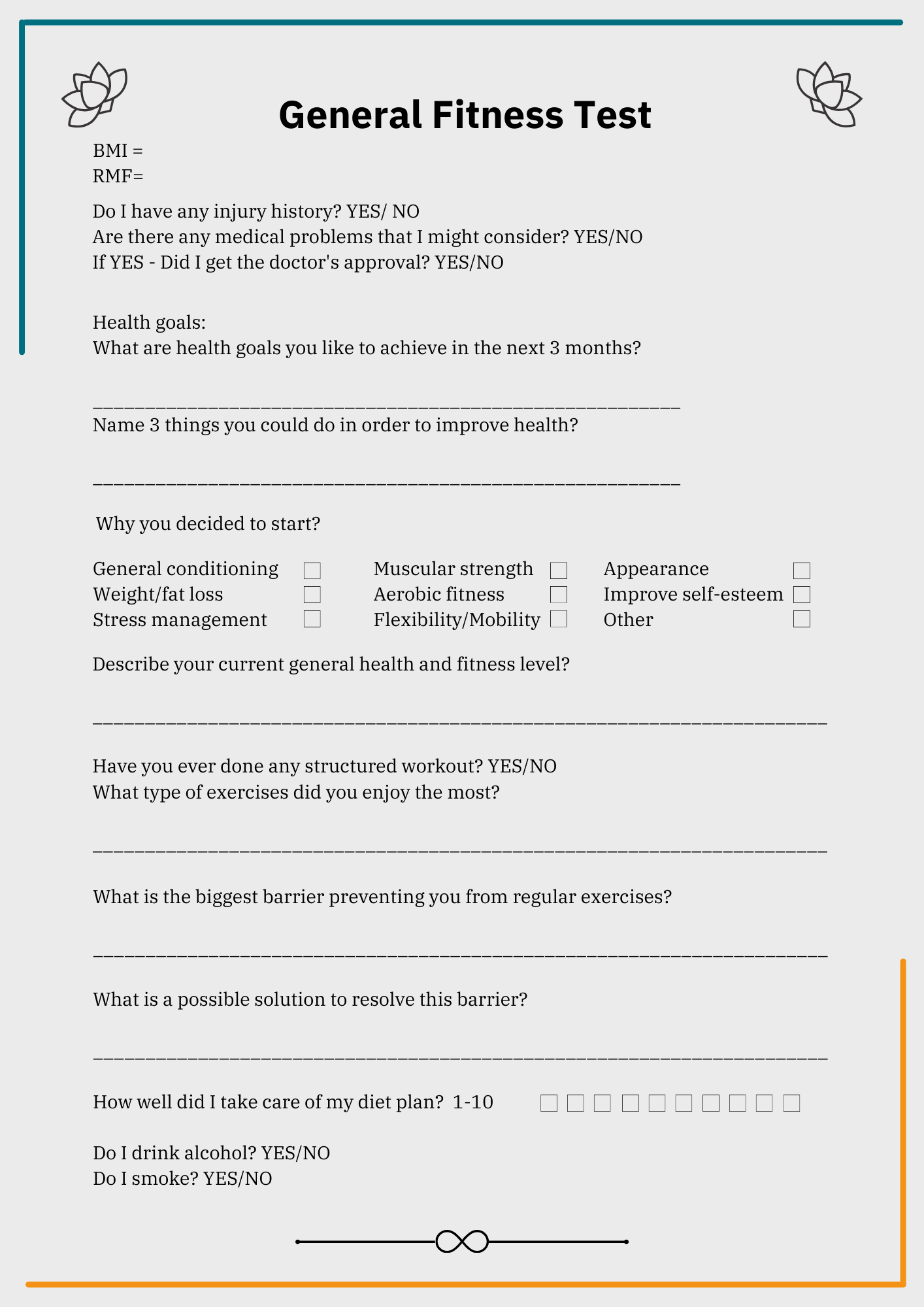
Fitness assesment
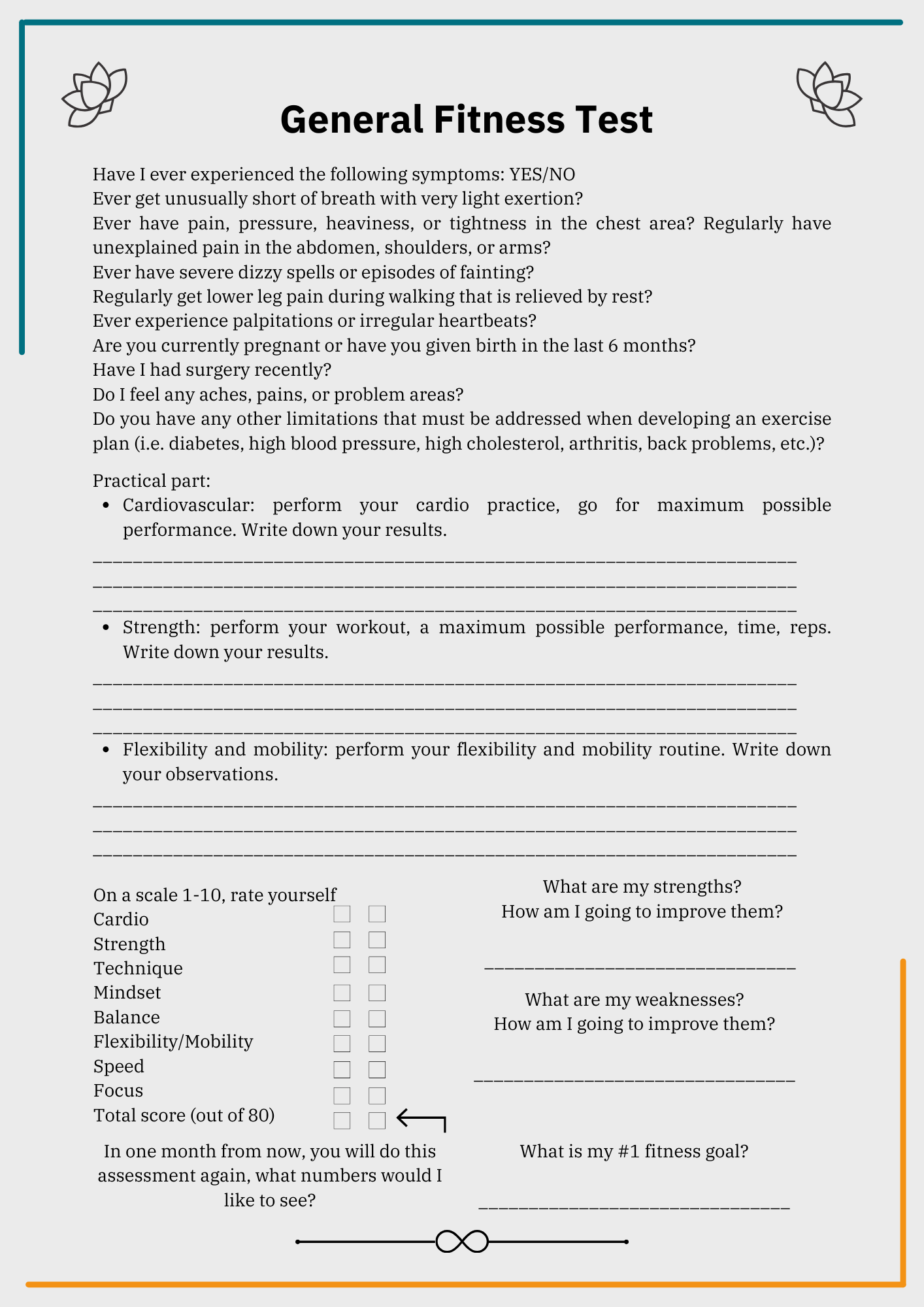
A fitness test, also known as fitness assessment is a special series of exercises, questionaries, tests to help evaluate your overall health, current fitness, also track the progress after a period of time. If you work out with a personal trainer, they should start with it, as it is a base for individual approach and safety measurements.
I made a very simple and general test. For most people, it should be enough. However, if you want to get more details as well as personalized workouts, contact your local gym or find a personal trainer.
I follow "The only person you should compare is you from yesterday" statement. This approach lets you focus on yourself, and stay motivated in a long run. Learn to challenge yourself, aim for being better each day.
Most of the fitness assessment includes:
General Health Evaluation - vital signs, injury history, doctor approvals if needed.
Body Composition Test - what makes total body weight, including muscles, bones, and fat. There are many methods including BIA, BMI, RMF.
Cardiovascular Endurance Test - how efficiently your heart and lungs work to supply your body with oxygen and energy. Most commonly used: a Cooper test, exercise stress with heart monitor and blood pressure cuff, VO2 max.
Strength and Endurance Test - measures the maximal amount of force a muscle group can exert at one time. Often used: maximum performance in some exercises at a certain time. Good to point out muscles which require more attention.
Flexibility/Mobility Test - measures the flexibility of your joints, and focuses on potential imbalances and limitations in range of motion. There is a variety of tests like shoulder flexibility testing, sit-and-reach testing, trunk lift testing.
Primal movements
There are seven basic movements the human body can perform and all other exercises are variations of these seven.
When performing all of these movements, you will be able to stimulate all of the major muscle groups in your body. These motions focus on multiple muscle groups.
Pull - pulling motion is any movement that pulls a weight toward your body or your body towards something. This can be a vertical or horizontal pull. The main muscles being worked in these sets of movements are the mid and upper back, biceps, forearms, and rear shoulders. Exercises in this group include pull-ups, dumbbell rows, Lat pulldown. If yoga is your only workout, it's important to include this one into a routine.
Push - this movement involves pushing a weight away from your body or your body away from an object. It can be vertical or horizontal. Exercises in this group include pushups and dumbbell shoulder presses. The muscles targeted are the chest, triceps, and front shoulders.
Squat - it occurs when you bend the hips, knees, and ankles to lower your buttocks towards the ground, keeping your body straight, and chest up. Great for lower body strength and balance. The squat targets quads, hamstrings, gluteal muscles, and calves.
Lunge - it occurs when you step forward, why bending one leg, and the other remains stationary. You focus on one leg at a time and moving forward. It also develops strength, balance, flexibility, and stability. It strengthens gluteal muscles, hamstrings, quads, and calves. Exercises in this group include side lunges, dumbbell step-ups, barbell alternating lunges.
Hinge - it occurs when you lean forward and hinge the hips. Essential for core strength and balance. The most crucial exercises in this group are deadlifts. These exercises build the lower back, core, and hamstrings.
Rotation - twisting is a movement when rotating the torso from side to side. It improves range motion and core strength. It includes exercises, like cable wood chops, seated medicine ball rotation, rotation medicine ball toss.
Gait - it's actually a movement that helps the body walk, jog, run. Gait is a combination of multiple movements (involving lunging, twisting, and pulling with the hamstrings). Exercises include jogging, jumping, walking.
After understanding the seven fundamental movements, you will be able to build a plan which will entail all the motions. It's generally to do some of those movements every day. It will be easy for you to build a great plan which will target all the muscle groups.
My routine
I don't play any sports. I practice regularly for a long time and I managed to create my own routine, I adjust the workout to personal needs, so it evolves and it's flexible. My personal goal is longevity. I focus holistically on developing all aspects of the body. I build my body in balance and put equal attention into every part of the body.
My favorite ones are:
yoga flow (medium intensively and pace) such as Hatha, free flow, Ashtanga.
calisthenics; with or without added weights,
cycling; 1-2 hours,
running; 5-10 km distances,
free-weights,
breathing techniques - MySpiritWay Breath and Ujjayi,
Sessions include:
Warm-up - Circular movements of joints, gentle stretching, performing upcoming exercise at a slow pace and low weight, often first round I do with fewer weights.
MySpiritWay Breath or intensive breathing during running. - few times a week
Running, or cycling, or other cardio routines - every second day (30-60 min)/short one before workout (5-10-15 min).
Yoga flow routine with attention to the breath - every second day, usually during the cardio day + short ones throughout the day (15-30-60 min).
Calisthenics workout for upper parts of the body - every second day (5-6 rounds 80% of current performance).
Calisthenics workout for legs, core, abs - every other day (5-6 rounds 80% of current performance).
Stretching after a workout.
Cool down. Shavasana (5min), gentle breathing (10-15 min), meditation (15 min) - always after the session.
Sometimes, instead of calisthenics, I go mostly for free-weights or a gym freestyle. I also like to learn and try new things, so my routine changes over time. Sometimes I add extra yoga practice that is often more intensive.
As time passes I experiment more and more with different mixed types of workouts. So when writing this article my routine might evolve into something else. I simply like to diversify things so I won't be bored.
Warm-up and cool-down
Warm-up is a very important and often overlooked part of the routine. It's a must be done before any exercise routine. It can help to prevent injuries, get your body prepared for a workout and increase athletic performance or even reduce soreness after the workout. It will increase your body temperature, activate your muscles, and help you build up proper techniques.
Important to notice that warm-up is different than, stretching after the session. Static stretching before a workoutcan actually decrease your potential strength gains and performance. However dynamic warm-ups are very important.
The key is to elevate your heart rate and let your muscles and joints through their range of motions, warm them up, and make sure everything is ready for the session.
How to do it: (example)
Discover your whole body. Focus on the range of motion of your joints. Some of them allow movement in one plane, others in two planes, and others in multi-axis. Be creative, play with it, try to discover all the possibilities.
Do a few reps of primal movements, without additional equipment or added weight. Try to gradually increase your tempo.
Do a slower/lighter version of movements you will be doing during the workout. Before you can do some short running or jogging (part of cardio on next page). First-round focuses greatly on the proper technique of each exercise, so you can use less weight.
Opposite to warm-up is cool down, do it always after the workout. The purpose of the cool-down is to return your heart rate close to resting. If you stop quickly without cooling down it can result even in dizziness and faint. It takes 3-5-10 min to cool down. Ujjayi, slow walk, meditation - are the perfect ways to cool down.
Cardiovascular exercises
Many people don't enjoy them as they often are challenging. It's generally about increasing your heart rate through intensive movement. When you are sweating, you feel your heart beating, breathing more heavily which are good indicators that you do cardio exercise. What is important to realize is that proper cardio is about doing exercises very intensively and about engaging fully.
It's recommended to incorporate cardio into regular routines due to benefits which include: lower risk of heart disease, helps to regulate blood sugar, lower blood pressure, reduces asthma symptoms, regulates weight, strengthens the immune system, and many more.
They are very important as a part of the workout routine. After the warm-up, it's another step that is worth taking. Cardio is especially effective as a separate routine.
Here are some examples which you can incorporate into your workout routine.
Cardio (CA ) - after warm-up
15 min - running on a treadmill, build up a proper tempo which is not slow jogging, you need to feel your heart pumping blood. You can build up the tempo gradually.
15 min - jumping rope - FAST tempo!
Cardio (CB) - separate routine
Good run - longer distance, which will challenge you each time.
Cycling - intensive, powerful especially on more steep terrain.
Dancing - check out Zumba.
Team ball sports like football or basketball.
Swimming, it's one of the ways to protect your joints.
Specially prepared set of exercises (often) 4-5 rounds and do as many reps as possible in one minute + 15 s rest between exercises. One of my favorites is - high knee run with boxing fists and burpees. Check on Youtube, there are plenty of recorded Cardio/HIIT/Tabata workouts. I found it easier to follow along with somebody.
Stretching and mobility
Compare a child with an elderly person. Naturally, at a young age, we are more flexible and as we get older we become stiffer. Not many people think that someday they will become older and weaker. There are obviously amazing examples of people who took care of their bodies in a good time, decreasing the chance of experiencing an inability to move freely. Regular practice is a remedy for beautiful aging.
There are two amazing schools Chinese and Indian which include - Tai Chi, Qigong, Kung-fu, and Indian - a variety of different yogas. They are systems that will help you to take care of the body as a whole, including physical exercises improving mobility and flexibility. But not only :)
It's recommended to do some simple stretching after each workout session. Apply some elements of yogic poses. You can find plenty of ideas by just googling Yoga Asanas Basic to Advanced.
It is also very beneficial to practice some form of mobility training every day, for example, in the morning and in the evening.
Generally, I am mostly focused on discovering Yogic paths, but I tried also Chinese Tai-Chi and Qigong, very powerful practices, that if you practice for some time you will be able to feel the energy flowing in your body. Truly powerful experience.
Consider this progression from the slowest to the most dynamic forms:
Yin Yoga - a slow-paced style of yoga as exercise. Positions are held for longer periods than in other styles. A good style to start with.
Hatha yoga - classical style of Yoga. You move your body slowly and deliberately into different posses while focusing on relaxation and mindfulness. You build a special connection with breath and posture. Some poses are usually held before you move into the next.
Ashtanga yoga is dynamic, challenging, breath-focused, even an athletics style of Yoga. Traditionally it follows the same routine each time. Ashtanga means eight limbs, which we can master to recognize our true nature.
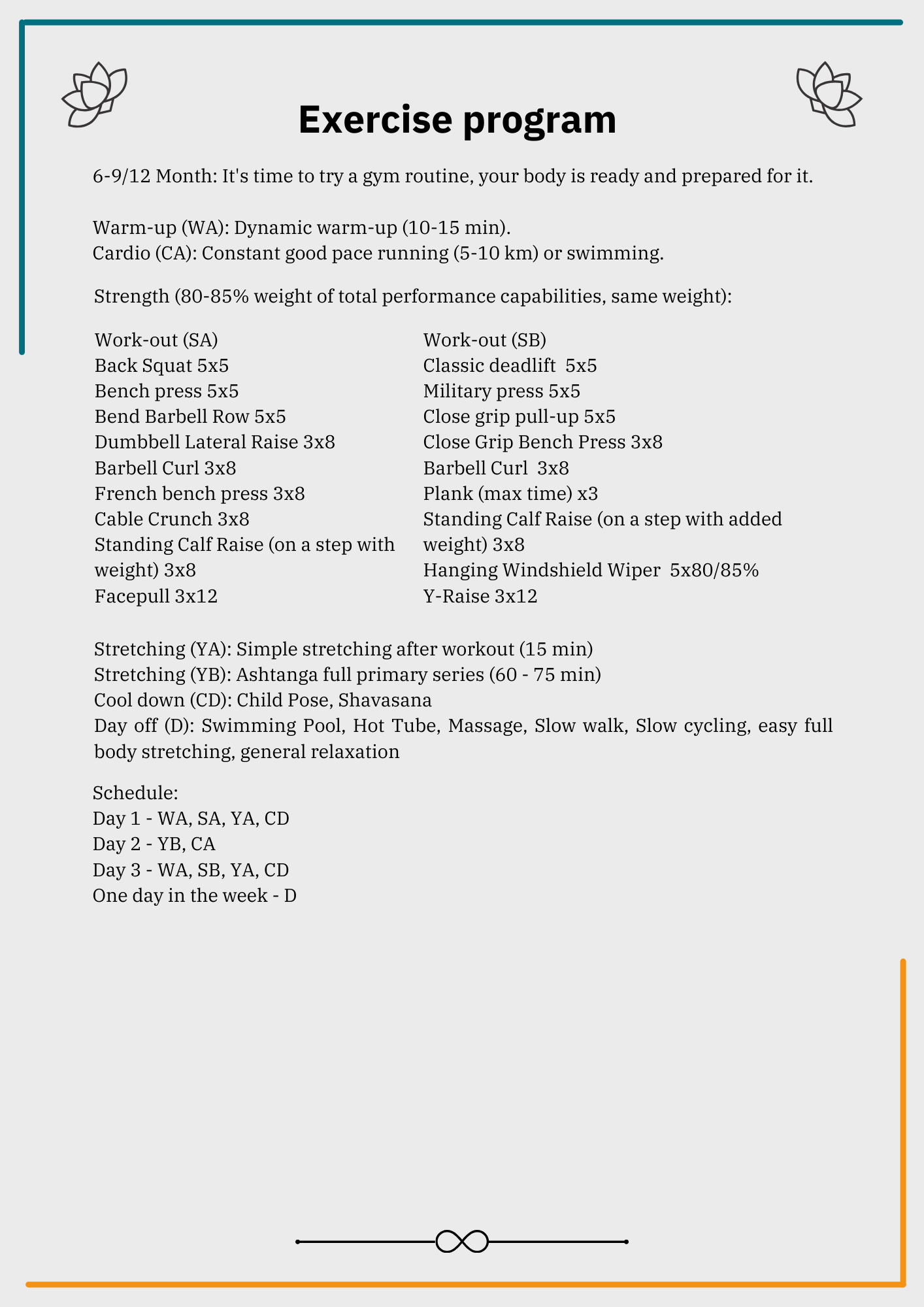
Exercise program
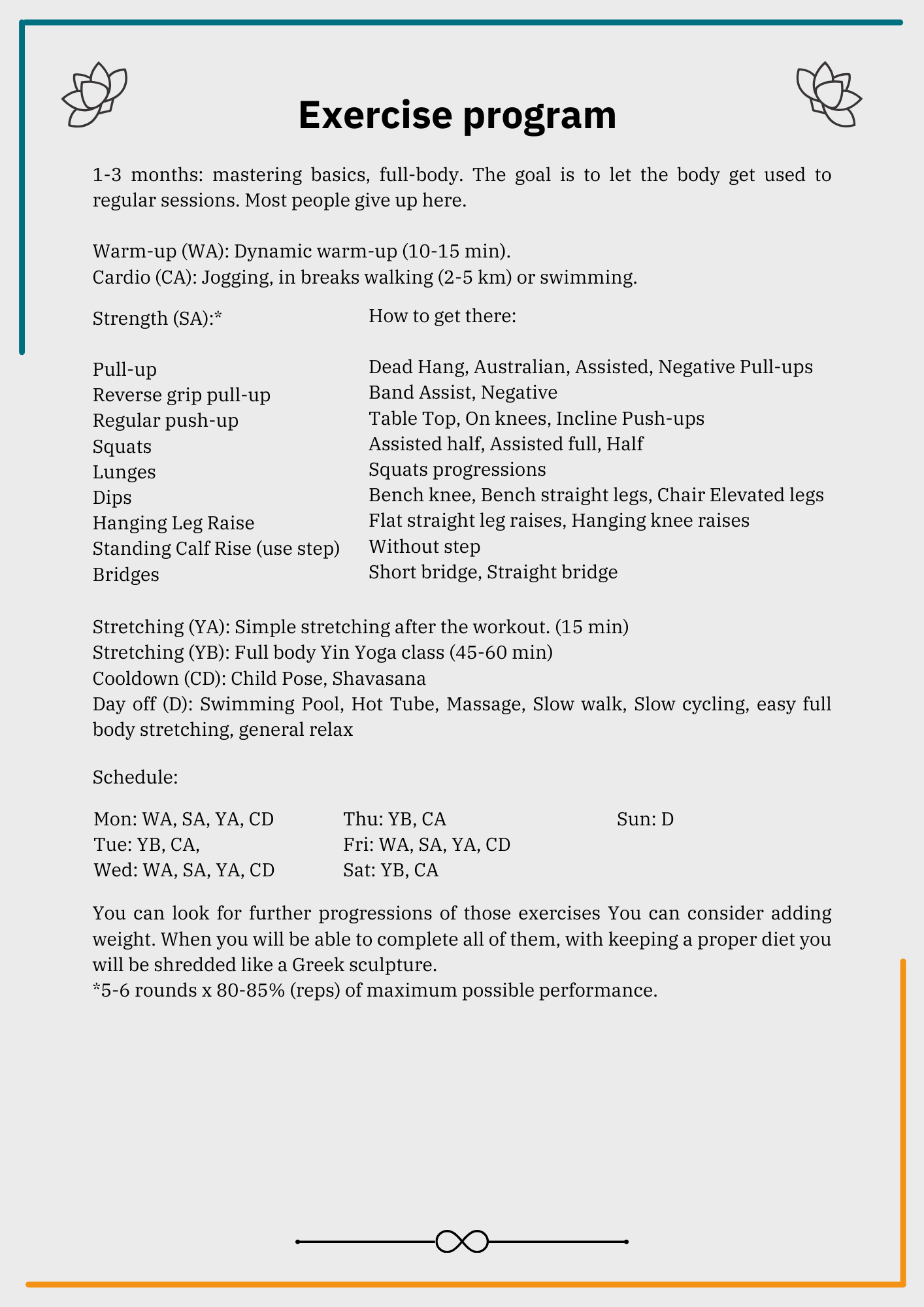
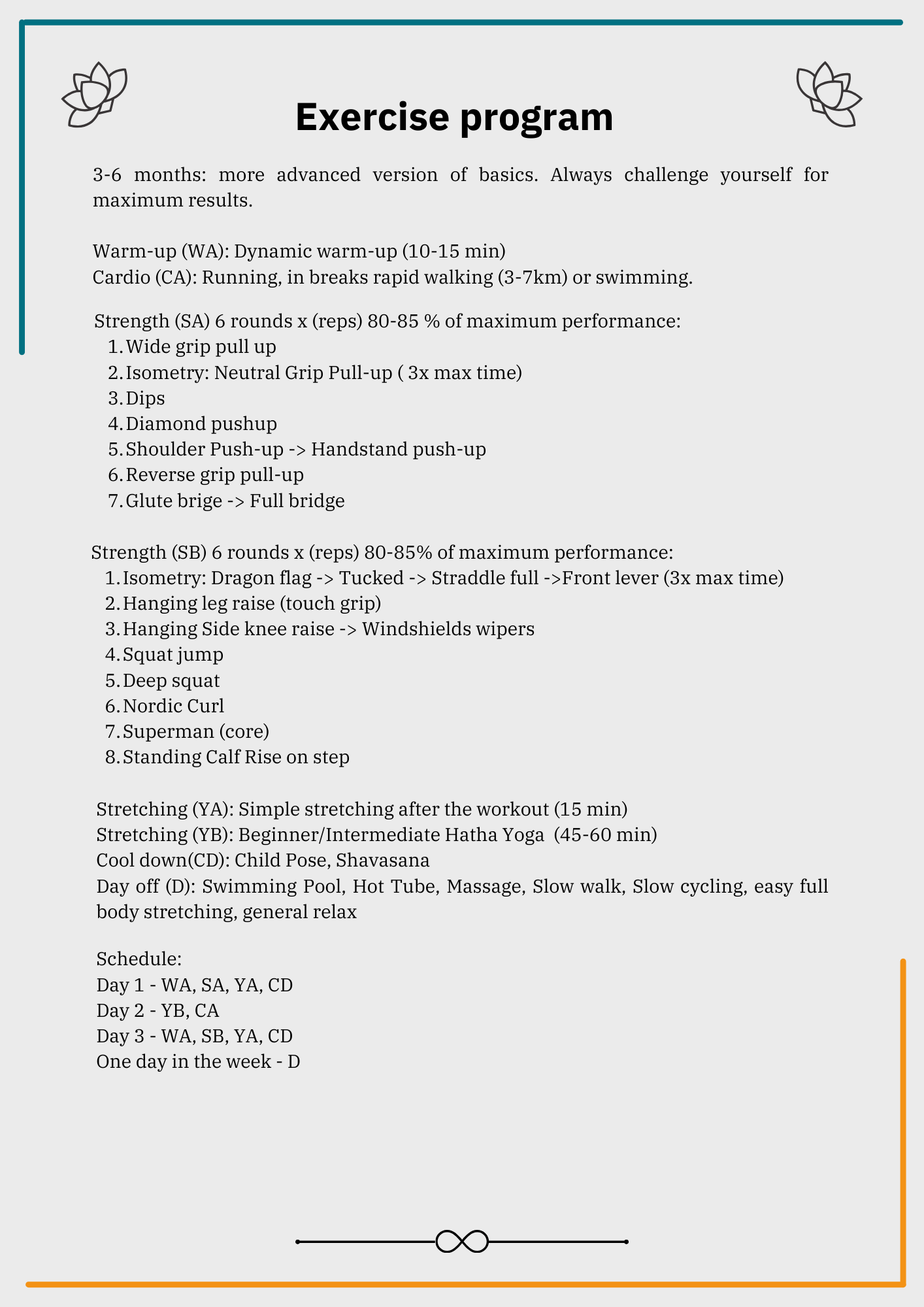
This is an example of an exercise program that is destined for balanced weight, or slightly underweight or slightly overweight, mainly for men. It's for people without any physical disabilities. For people who just began, or trying to get back into exercising. The first two programs can be practiced by everybody(if you need, check with your doctor first).
It's difficult to make one best-fit plan when everybody is on a different level, and it depends on a variety of factors like age, fitness level, goals, and any physical restrictions. There are many approaches to exercise programs, and the best ones are adjusted for personal needs. You will definitely find plenty of trainers on Youtube, or locally. Remember a proper diet plan is key to results.
If you are in the higher category of overweight/obese put more pressure on active exercises (cardio) which will help you burn fat. Find out what is your fat-burning pulse rate. Be gentle with your joints, especially knees. Start slow and accept, that it takes a long time to lose weight in a healthy way. Incorporate activity also after the gym, like walking, cycling to the job. You can do a modified version of the exercises.
If you are way underweight, put more pressure on fewer reps but, more heavyweight, do exercises slower.
If you are a female, in most cases you might want to focus more on the legs, and ABS exercises, as well as cardio. The common misconception is that women must do exercises only for women. You can do all those exercises included in this routine. Just adjust the program for your own needs and goals.
After a whole year of regular training, you should be able to adjust the program for your own needs, that's why it's good to do your own research, try new things in order to find (Your)SpiritWay.
Some tips
Stay hydrated - it's essential to maintain healthy hydration levels. Always carry with you a big bottle of water.
Diet plan - make sure to optimize your diet to support your workout plan.
Make sure to relax - it's important, that after an extensive session, you will spend some time relaxing. Massage, relaxing in a steam bath, hot pots are great. You can even take a day off during the week. It is very helpful and even beneficial for muscle growth. A slow walk in nature will fit perfectly for this day.
Get enough sleep - regeneration of the body is as important as the activity. Take care (hope you did) of good, quality sleep.
Don't exaggerate - listen to your body. To progress, it takes time, and a regular rest/activity process. When practicing, observe how your body reacts, so you won't overdo exercise and get some injuries.
Find your favorite coach - you can start with your local gym or simply with Youtube recordings. Aim for competent coaches who will be able to make sure you will do exercise safely.
Do it safe - make sure to understand the proper technique. It's much more beneficial to aim for fewer reps but more technically correct. It will help you avoid injuries as well.
Move every day - I am not talking about hardcore exercises, as it will not be beneficial for you. Apply some physical activities into your daily routine. Even evening walks, or stretching will do good.
Breathe - it's very important to focus on proper breathing, it will help you improve your performance. Inhale through a nose and exhale through the mouth. Inhale deeply during the rest phases of an exercise, and exhale forcefully in the work phases.
Start with smaller weights to learn proper technique and avoid injuries.
Soreness - gentle stretching, cold bath, muscle massage are the best ways to deal with soreness. Remember to provide enough proteins.
Simply have fun. One more time, find your own path. Try different types of routines. Share your style on MySpiritWay Forum ;)
Always stay motivated
Deep auto-analysis will help understand, or ask yourself:
Why do I really want to practice on a regular basis?
What is the core of this decision?
What regular practice can give me?
Find an activity that brings you fun - that's the key to never stop.
For some, it works better to stick to the fixed routines, while for others, enjoy more mixing activities. It all depends on your goal, but overall it's about feeling great and living a long happy life.
Consider, joining a gym or taking a virtual class, hiring a personal trainer, doing team sports, or finding a workout partner. You can ask your accountability partner, so stay in touch and motivate one another. Post your progress on our Facebook group so we can support one another.
You can also track your progress, logging weightlifting levels or noting running times, taking pictures, measuring yourself. It will help you improve and always beat new records. It's amazing to see pictures before and after to keep you always focused! Who knows maybe you will be ready to motivate others? When you track your progress, make sure to always raise the level of difficulty by adding weights, doing exercise more accurately, and following progressions. Remember to not become a slave of numbers. It's most important to focus on the path, and observe the body during the sessions. Look at the mirror, as it's your determination.
Always, challenge yourself, it's fantastic to feel this accomplishment after difficult exercises, which you might avoid. Very often those are, in what you are the weakest, and should focus the most.
Some people struggle with motivation not only when it comes to working out regularly, but generally in life. It's connected to low energy levels, where the mind and body just want to rest and that they don't want it strong enough.
Make sure that even if you fail one day, try again as soon as possible!
Conclusion
Exercise for this month is..., you guessed it! Start practicing regularly.
This month exercise plan is given to you, so make sure you find good use of it in your daily routine. Remember everything is possible with implementing the Kaizen approach in order to get on your path to transforming your life.
Follow the exercise program if you feel it's suitable for you. Or look for your own way; apply to the local gym, find your personal coach, look for sessions on Youtube.
Practice, Practice, Practice!
Remember:
Stay hydrated
Make sure to relax
Get enough sleep
Find your favorite routine
Do exercises safely
Move every day
Pay attention to your breath.
Start with smaller weights to learn proper technique and avoid injuries.
Gentle stretching, cold bath, muscle massage are the best ways to deal with soreness.
Provide enough proteins.
You get better with every practice, but don't think that it gets easier. This means that it's time to upgrade to more advanced techniques. Do it slowly and with respect to your body.
Regular physical exercises are good to get in shape, to become stronger, or keep the body in a balanced tone. When you feel good in your body, it boosts your self-esteem and well-being - a truly amazing feeling!

MySpiritWay Practical Spirituality. We can help you; create a supportive lifestyle,accelerate spiritual and personal growth, reduce life suffering, raise your consciousness, and achieve life satisfaction across all fields.
Simplified Practical Spirituality
Everything you need to know about practical spirituality and the evolution of consciousness.
Get Access here
MySpiritWay © www.myspiritway.org