#24 - Traditional Chinese Organ Body Clock
Chinese Organ Body Clock
In Traditional Chinese Medicine, it is believed that each organ has its peak of higher and lower energy. We can create a proper everyday routine based on these ancient rules. We are also able to communicate with organs; when we have low energy during the time when we usually should have a high energy level, that means potential pathology in this organ is present. Traditional Chinese Organ Body Clock is about connecting specific functions of the body to specific times on your internal clock. Each organ has a two-hour time period each day when it reaches its peak of activity.
Practitioners believe that daily dips and spikes in vitality can give you valuable information about your health imbalances. It's about developing a connection with your body, which communicates through symptoms and can give clues to what we need to pay attention to.
In Ayurveda, Chinese Medicine, and other systems I was studying, it's believed that any disfunction is to give a sign to put more attention to some specific spheres in our lives. This is about a holistic way of looking at the body. As well as understanding that everything is interconnected and works as one organism.
It's believed that each organ is tied to corresponding emotion. I don't have enough observations to confirm it, so I decided not to include them in this course.
This topic will give us a deeper understanding, that we are a part of the bigger picture. We are parts of a huge system, part of nature, so we tend to follow natural rhythms both internal and external.
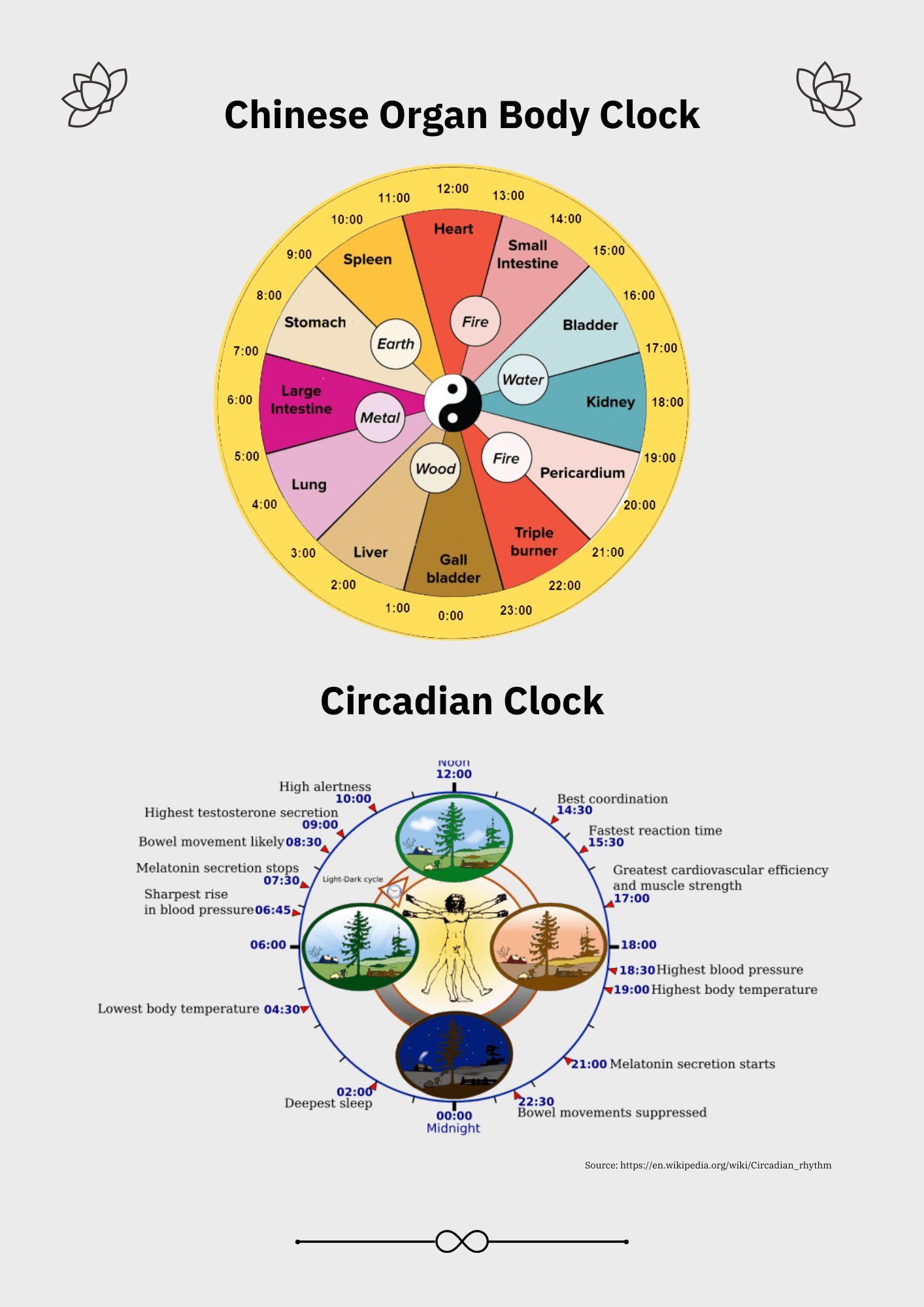
Circadian clock
It doesn't come directly from the idea of organ activity clock, however, there are some similarities, and this topic is backed up with more confirmed research.
Circadian rhythms are 24-hour cycles and are part of the body's internal clock. One of the most well-known circadian rhythms is the sleep-wake cycle.
Different body systems follow it and are synchronized with the internal master clock in the brain. This system is directly influenced by the environment, especially the daylight.
When properly aligned, it promotes consistent and restorative sleep, it plays an integral role in diverse aspects of physical and mental health. This cycle exists in all types of organisms. It even helps flowers open and close at the right time.
The Circadian Pacemaker is located in the part of the brain called the hypothalamus, and highly sensitive to light which is the most powerful influence on circadian rhythm. There are also other factors like exercise and temperature. During the day, the light exposure causes the master clock to send signals that generate alertness and help to keep us awake and active. As night falls, the master clock initiates the production of melatonin. People with consistent circadian rhythm practice healthy habits.
What can cause desynchronization:
Working overnight
Working shifts with irregular hours
Travel to places with different time zones
Sleeping late on irregular hours
Possible medications
Cumulation of stress
Some health and mental conditions
Bad sleeping habits
As it was mentioned, a proper sleeping routine will help you regulate the desynchronized circadian clock. It is very important to take care of it, as it will reduce stress, the chance of depression, tiredness throughout the day, and all sleep loss connected problems.
Disruption can affect your organs, cardiovascular system, metabolism, and skin. As well as a higher chance of diabetes, obesity, mental health conditions, and others.
On the next page, you can find more details about the Chinese Organ Body Clock.
3:00 - 11:00
3:00 - 5:00: Rest and Breath
Organ: Lungs
5:00-6:00: it's the perfect time to wake up. This time you can enrich your body with oxygen using gentle breathing. It will assist the elimination and boost your immunity. It's a great time for breathing techniques, remember Ujjayi? You can apply it just after waking up.
5:00-7:00: Morning elimination
Organ: Large intestine
Warm water habits, do Sun Salutation or other gentle exercises which are perfect for this time. Coffee in the morning might not be the best decision as it might lead to a midday crisis. If you want to drink it, have it rather after breakfast. You should also give yourself time upon waking up to relax and allow your body to naturally detox. This is the time to release bowels and remove toxins from the day before.
7:00-9:00: Warming breakfast
Organ: Stomach
We heard many times, that breakfast is the most important meal of the day. Go for warming, healthy breakfast, some porridge type of food with seeds and nuts. Eat everything that is warm, so it will support heat at the peak of the activity of the stomach. So, no cold smoothies. For many, this time is good for things that require concentration like studying. Remember not to read newspapers with shocking or negative headlines, it might affect your mood and make you feel stressed. The stomach is the main organ to cumulate the stress, so you should avoid negative information. Instead, a moment of gratitude for breakfast would be a good addition to the meal.
9:00-11:00: The most demanding task of the day
Organs: Pancreas and spleen
If you haven't eaten by that time, it's good to consider having some food. If you follow the whole routine you should have a lot of power to do the demanding activities. Usually, you feel very positive this time. Also, it's a good time for an intensive workout or brainwork.
11:00 - 19:00
11:00-13:00: Yummy! Lunchtime!
Organ: Heart
I found out that 12:00-12:30 is the best time if want to eat heavier meals. If you eat meat or fish it's a good time to consider it. If you decide to have an intensive workout before 11:00 - 12:00 it can be your meal afterward, so make it nutritious. Great time for brainstorming, and other activities you love and enjoy.
13:00-15:00: Good or bad?
Organ: Small intestine
The process after a second meal, separating usable energy from waste. Sort and absorb the food type or "mode". It's a good time to have a nap if possible. (12:30-13:00) - 20-30 min.
15:00-17:00: Snack time!
Organ: Bladder
After the nap, you can wake yourself up with a powerful breathing technique. It can be also a good time for a workout. (16:00 - 17:30) It's time to eat some healthy snacks. A cup of tea is a great idea to support the detoxification process. Even when it's quite late, if you keep healthy habits, you should be energized. Some people enjoy this time for activities that require minimal brainpower.
17:00-19:00: Last meal of the day
Organ: Kidney
It's a perfect time for light supper (19:00-20:00) full of vitamins and minerals, and low in sugar. This time is dedicated to building bone marrow and storing nutrients. Great time to have a walk or have a massage 19:00 -20:00. Generally, the best time for relaxation, especially when you had a filling meal.
19:00 - 3:00
19:00-21:00: Preparation for a good rest
Organ: Pericardium
This time is good for grounding activities like meditation, slow stretching, relaxing with loved ones, taking a bath. Apply evening rituals, calm down and prepare for regenerative sleep. It is the perfect time (especially closer to 21:00) to engage in intercourse.
21:00-23:00: Proper hydration
Organ: Triple Heater, Endocrine system
You have already learned about signs of not being hydrated properly. It's a perfect time for a good cup of warm water to support metabolism. Drink just enough, so you won't wake up in the middle of the night to empty the bladder. Time for endocrine and metabolic regulation. At this time you should be sleepy. It's good to lay down to bed at 22:00.
23:00 - 1:00: Sleep Time!
Organ: Gallbladder
23:00 It is maximum when you should be already in Morpheus's arms. It's actually best to go to bed at 22:00 and let yourself relax to fall asleep no later than 23:00.
1:00-3:00: Body detox
Organ: Liver
You should be already deep sleeping. If you wake up at this time, it can also mean that you have eaten too much or something heavy to digest. If you expect a high-stress level you might wake up during this time. It's believed that this time is dedicated to blood detox, rest, and recovery of the body, preparing it for the next day.
My perfect day routine
I always try to do my best each day. This is my daily routine written on 22.04.2021. It might change with time. There will be many practices through this course, so you can make your own routine that will work the best for you.
6:00 - Wake up
6:05 - Kegel practice
6:15 - Recall and write down dreams
6:25 - Warm water morning routine
6:30- Gentle yoga asanas, Gentle Breathing Methods, Short Meditation
7:00 - Morning elimination, usually on time
7:10 - Cold Shower for 2 minutes and washing procedures
7:20 - Supplements + Breakfast + Gratitude Practice
8:00/8:30 - Jogging or/and Calisthenics workout + Cold Shower
9:30 - 12:00 - Work + Tea
12:00 - 12:30 - Lunch
12:30 - 13:00 - (Usually) A short nap
13:00 - 20:00 - Work + Stretching/movement through the day or intensive workout if I didn't do it in the morning + Power Breathing
15/16/17 - (Between these times) Snack + Relax
19:00 - 19:30 - Last meal of the day
19:30 - 22:00 - Some working, planning + grounding activities + sex
22:00/23:00 - Bedtime + Energy flow practice + OOBE/LD techniques
Every Friday is a Fasting Day. Usually water fasting.
From time to time - Dopamine Detox, Day off + Relaxing activities.
There are other activities which are not mentioned as they are infrequent, it includes special processes, exercises, and some relaxation.
You can notice that most of my time I am working on projects, sometimes I work more, sometimes less, on average probably 10 - 12 hours a day. Thanks to good habits I have a lot of energy and joy to focus on things I truly enjoy.
If you are working permanently somewhere, there are no excuses, you can create your perfect daily routine based on your current situation. Yes, it is possible!
Exercise
I encourage you to build a stronger connection with yourself, to become more aware of all those small signals like pain, mental discomfort, energy levels, disease, and organ dysfunction. Check the topic of Total Biology, there are some pretty nice books to be able to decode your body signals.
Time for exercise
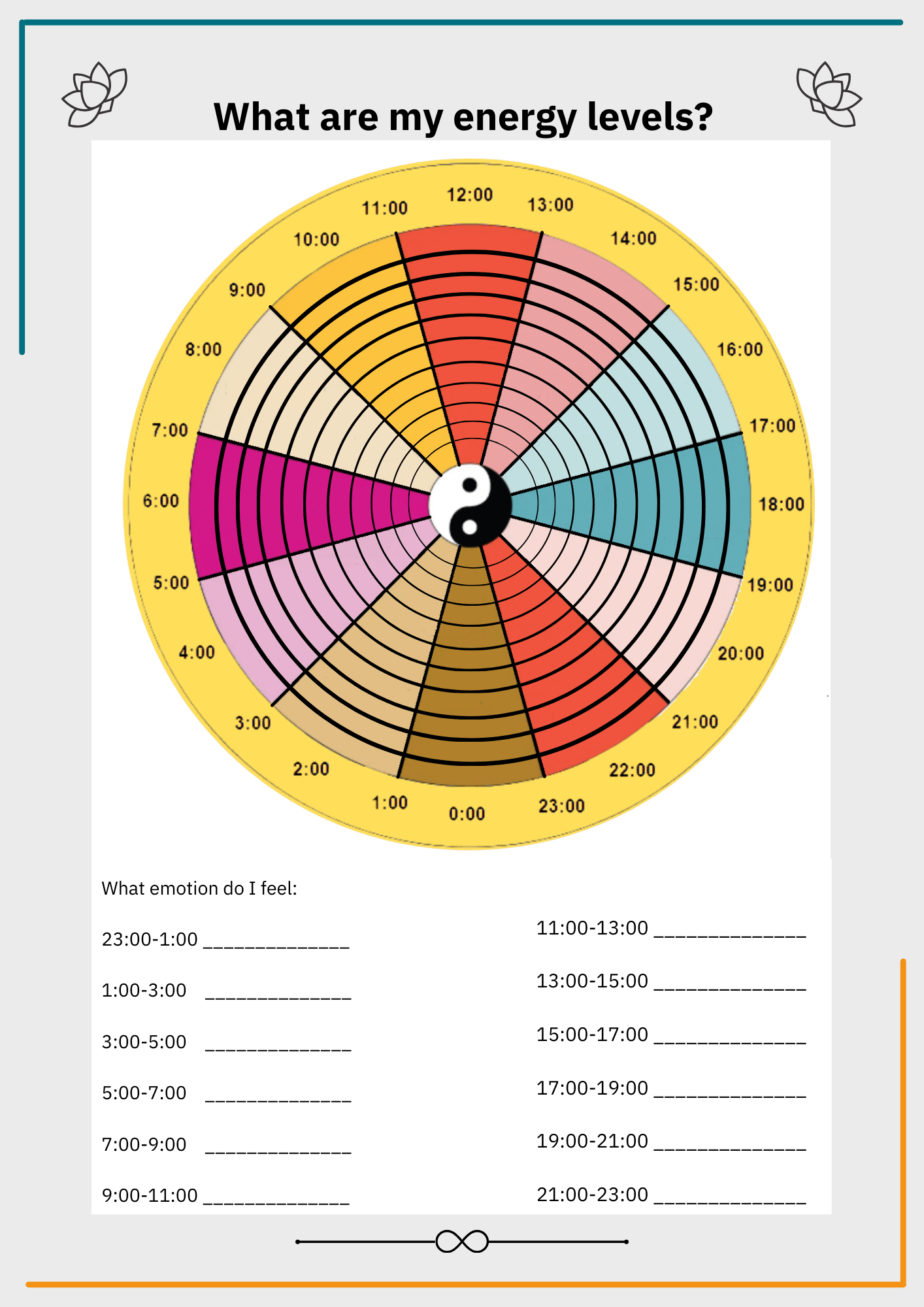
Note down how do you feel every 2 hours, especially if it comes to energy levels, but obviously not during the time you should sleep. I created a special template for you to follow.
Ask yourself:
What is my energy level right now?
Is my body giving me any noticeable signs?
What emotions am I feeling?
Mark on 1-10 scale how you rate your current energy level.
1 for extremely tired, exhausted.
10 for full of energy "dancing and singing mood".
Do this exercise for the whole week and if your daily routine will change, apply this for a couple of days extra to see how it affects your energy levels.
If you are ready, then try to make your own perfect day routine and aim every day to live according to it.
Conclusion
It's good to be aware of this ancient Chinese knowledge, it definitely makes a lot of sense to build a balanced daily routine.
Many of us work permanently, so it might be difficult to apply all habits according to it. Especially challenging for the evening, night shift workers, and for active travelers who move from place to place. In my opinion and according to researches, it might not be best for our health to work during the night. It definitely messes up the circadian rhythm. A shift worker is at increased risk of health problems, such as digestive upsets, obesity, heart disease, and accidents due to excessive daytime sleepiness. That's why it's strongly recommended for those working at night shift to take extra care of your nervous system and overall health, also by paying more attention to the signs your body might be sending.
I meditated on this topic, interviewed some people in order to find a solution. Apart from changing work, obviously, as it's not always possible, we can try to get longer and more regular vacations - to bring more balance for the whole system and learn to relax and rest during days off.
We all should be very thankful for all those public services like policemen, firefighters, nurses, doctors as they sacrifice their own well-being to serve civilians.
Take an action! Take care of a healthy everyday routine. Do the most demanding activities at your peak hours, or just work more intensively so you can find a norm at work. When you feel low energy, let yourself slow down instead of boosting yourself with coffee or energy drinks. As it will make you more tired in the long run. It's better to do some powerful breathing techniques to wake up. Our bodies have an amazing capability to adapt, and if we feel mental, emotionally, and physically healthy, it might be all right for us to work late hours.
Become more aware of signs which you are given every day, and accept it humbly so good health will serve you for a very long time.

MySpiritWay Practical Spirituality. We can help you; create a supportive lifestyle,accelerate spiritual and personal growth, reduce life suffering, raise your consciousness, and achieve life satisfaction across all fields.
Simplified Practical Spirituality
Everything you need to know about practical spirituality and the evolution of consciousness.
Get Access here
MySpiritWay © www.myspiritway.org