#8 - The Wheel of Life
What is the Wheel of Life?
The Wheel of Life is a powerful tool designed to help you assess and improve the balance in your life. Typically, it encompasses 8-10 key areas essential for a fulfilling life, but in this article, we’ll explore 12 categories to provide a more comprehensive view of the different aspects that shape your life.
Often referred to as the Coaching Wheel or Life Balance Wheel, this tool visually represents your current level of satisfaction across various life domains. By mapping your satisfaction onto the wheel, you gain an immediate snapshot of your life’s current state, making it easier to identify areas that need attention and improvement.
You’ll start by evaluating your current situation and setting clear, achievable goals for where you want to be. The exercises included will guide you through this self-assessment, helping you gain deeper insights into your life and understand the steps needed to enhance your balance and satisfaction.
Ultimately, the Wheel of Life not only helps you see where you stand but also encourages self-reflection, helping you ask meaningful questions, build self-awareness, and take deliberate actions toward achieving a balanced, fulfilling life.
Self Reflection
Self-reflection is a powerful tool in the journey toward a balanced and fulfilling life. It involves taking a step back to examine your thoughts, feelings, actions, and overall state of being. Through self-reflection, you gain a clearer understanding of where you currently stand in your life and what steps you need to take to move forward.
The Wheel of Life is an excellent tool for facilitating this process. By reflecting on each aspect of your life, you can evaluate your current level of satisfaction and identify areas that need attention. This reflection isn’t just about identifying what's wrong; it’s also about recognizing what’s working well and how you can build on that foundation to create the life you truly desire.
Self-reflection is not a one-time activity but an ongoing practice that evolves as you grow and change. As you continue to reflect, you’ll develop a deeper understanding of yourself, your needs, and your desires, which will guide you toward making decisions that align with your true self.
The Wheel of Life Exercise
1. Prioritize and Rank:
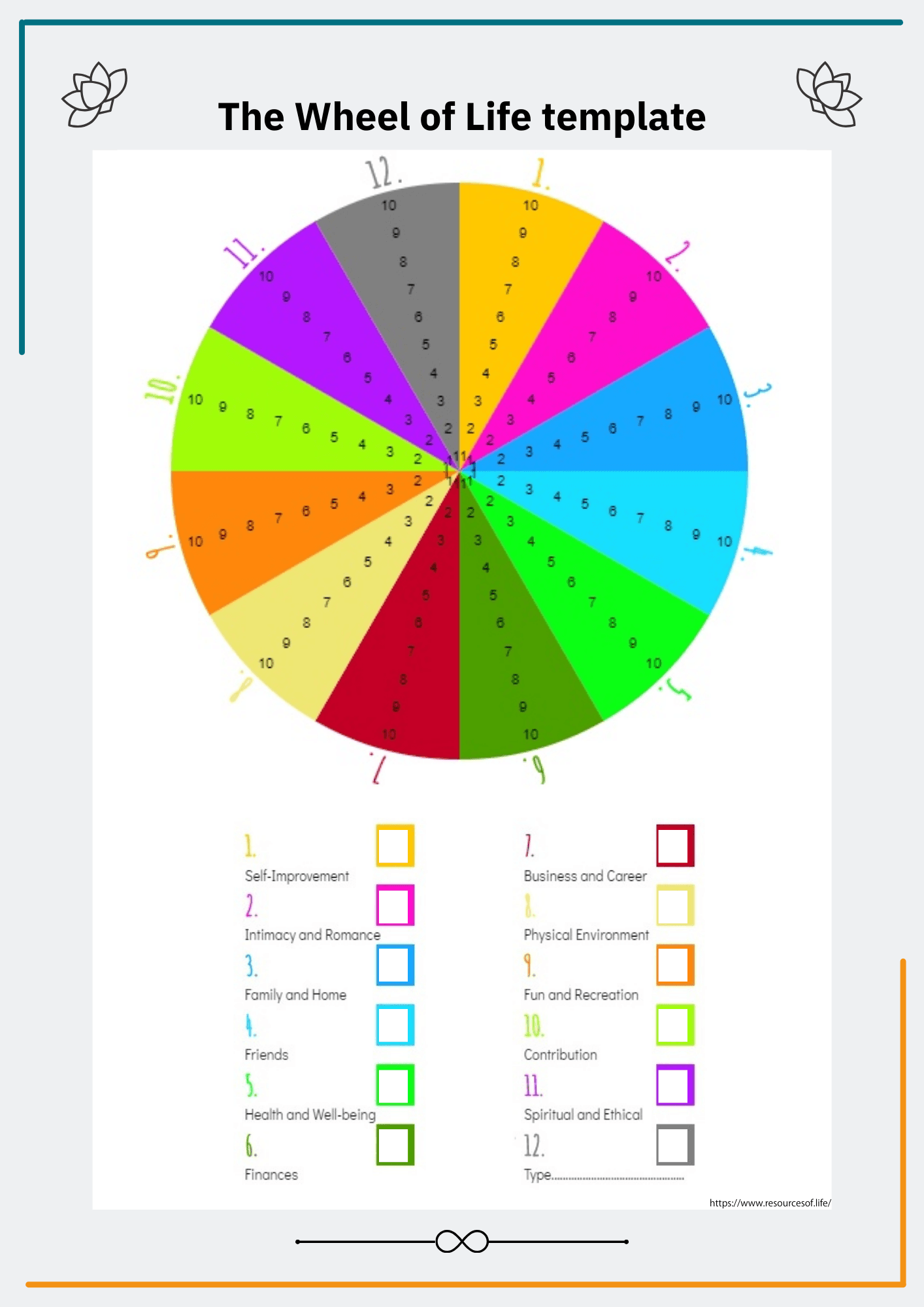
Begin by identifying which areas of your life are most important to you. Assign numbers to each category in the empty squares beneath the circle, indicating their priority. Ask yourself: Why is this area more important than others?What makes this aspect of my life crucial right now? Understanding the interconnectedness of these areas will help you see why certain aspects might hold more significance than others.
2. Evaluate Your Current Satisfaction:
Assess your current level of satisfaction in each area by rating it on a scale from 1 to 10. Use guiding questions to ensure you fully understand what each category represents. Take your time to answer thoughtfully, as this will provide a clear picture of where you stand now and where improvements are needed.
3. Identify Desired Satisfaction Levels:
Mark where you want to be on the same 1 to 10 scale. The difference between your current rating and your desired rating indicates the work required to achieve your goals. Remember, the larger the gap, the more deliberate effort will be needed in your daily routines. Analyze which areas demand the most attention and which can be improved simultaneously, as some categories may be interrelated.
4. Set Goals and Develop Habits:
Understanding the areas that need improvement is just the first step. The next is setting specific goals to bridge the gap between where you are and where you want to be. What habits do you need to cultivate to enhance these aspects of your life? Use a daily habit tracker to monitor your progress and stay committed to your growth. Consistency is key to transforming these areas of your life and achieving the balance you seek.
The Wheel of Life Categories
This Wheel of Life is very unique as it has one empty space, which you can fill up yourself.
So we will have 12 categories in total.
It goes as following:
1. Self Improvement
2. Intimacy and Romance
3. Family and Home
4. Friends
5. Health and Wellbeing
6. Finances
7. Business and Career
8. Physical Environment
9. Fun and Recreation
10. Contribution
11. Spiritual and Ethical
12. Empty - ready to be filled with your idea :)
1. Self-Improvement
Self-improvement is the deliberate and ongoing process of enhancing various aspects of your life to become the best version of yourself. It’s not just about achieving specific goals but also about cultivating a mindset that prioritizes growth, continuous learning, and self-awareness. Self-improvement encompasses a wide range of activities and practices, from developing new skills and refining existing talents to fostering emotional intelligence and building healthier habits.
At its core, self-improvement is about taking responsibility for your personal growth. It’s an acknowledgment that while external factors can influence your life, the power to shape your future lies largely within you. This journey is deeply personal and unique to each individual, involving a commitment to consistent self-reflection, goal-setting, and the willingness to step outside of your comfort zone.
Key Questions for Reflection:
What is my personal definition of growth? Reflect on what growth means to you.
How do I envision myself evolving as a person? Visualize the person you want to become. What traits, skills, and habits do you see in your future self? How does this vision align with your current path?
Am I investing enough time and energy in my personal development?Consider whether your daily habits and routines support your growth. Are you dedicating time to learning, self-care, and self-reflection? If not, what can you adjust?
What specific actions am I taking to build myself up continuously? Identify the concrete steps you’re currently taking toward self-improvement. Are they effective? How can you enhance or expand these actions to ensure ongoing progress?
What mindset shifts do I need to make to support my growth?
Evaluate your current mindset. Do you need to cultivate more positivity, resilience, or open-mindedness to support your journey?
Why am I determined to expand and grow continuously Reflect on your motivations for self-improvement. Are you driven by a desire for success, personal fulfillment, or perhaps to make a positive impact on others? Understanding your "why" will strengthen your commitment to growth.
Do I have strong, healthy habits that support my self-improvement journey? Assess whether your habits contribute positively to your growth. Are there habits you need to develop or strengthen to better support your goals?
What are the biggest obstacles to my self-improvement?Acknowledge the internal and external barriers that may be hindering your progress. Are there limiting beliefs, fears, or habits that you need to address?
How do I handle failure and setbacks in my self-improvement journey?
Reflect on your response to challenges. Do you give up easily, or do you see failures as opportunities to learn and grow?
Am I being too hard on myself, or do I need to push myself more?Assess whether you are maintaining a balanced approach to self-improvement. Are you being too critical of yourself, or are you not challenging yourself enough?
What does my ideal self look like in 1, 5, or 10 years? Visualize your future self. How do you want to grow over the years, and what steps can you take now to start moving in that direction?
What legacy do I want to leave behind? Think about the long-term impact of your self-improvement journey. How do you want to be remembered, and how does that influence your current actions?
How satisfied am I with my progress in self-improvement? Rate your satisfaction with your current level of self-improvement. Are you content with your progress, or do you feel there’s room for improvement?
Action Steps:
Identify Areas for Change: Reflect on the aspects of your self-improvement journey that need adjustment. Where do you feel a gap between your current state and your desired growth?
Set Clear Goals: Define specific, actionable steps you can take to enhance your self-improvement efforts. Whether it’s adopting a new habit, dedicating time to learning, or seeking mentorship, clarity in your goals will drive your progress.
Create a Plan: Develop a realistic plan that includes daily, weekly, or monthly actions that support your self-improvement. This plan should be flexible enough to adjust as you grow, yet structured enough to keep you on track.
Monitor and Reflect: Regularly review your progress, celebrate small wins, and adjust your approach as needed. Continuous reflection ensures that your efforts remain aligned with your goals.
Commit to Continuous Growth: Embrace the mindset that self-improvement is a lifelong journey. Stay open to learning, adapting, and evolving as you move toward becoming the best version of yourself.
2. Intimacy and Romance
Intimacy and romance encompass the physical, emotional, and spiritual connections that form the foundation of romantic relationships. These connections can manifest in both sexual and non-sexual ways, nurturing feelings of love, passion, and deep attachment between partners. At the heart of this category is the human desire for belonging and love—fundamental needs that contribute significantly to our overall well-being and happiness.
A healthy romantic relationship is built on mutual respect, understanding, and communication. It involves recognizing and meeting each other’s needs, whether they are emotional, physical, or spiritual. This category invites you to reflect on the quality of your current relationship, or if you are not in a relationship, to consider your own needs and desires in this area. It’s essential to understand the reasons behind your current relationship status—whether it’s a conscious choice based on self-love or influenced by other factors.
Key Questions for Reflection:
What does a romantic relationship mean to me?Reflect on your personal definition of a romantic relationship. What values and qualities are most important to you in a partnership?
How do I define intimacy?Consider what intimacy means to you beyond just the physical aspect. How do emotional, intellectual, and spiritual connections play a role in your relationships?
Are we spending enough quality time together?Evaluate the time you and your partner dedicate to each other. Is it meaningful, and does it strengthen your bond?
Do I genuinely enjoy the time we spend together?Think about the activities and moments you share with your partner. What do you enjoy most, and are there areas that could be improved to enhance your connection?
Do we understand each other’s love languages?Reflect on whether you and your partner are aware of and responsive to each other’s love languages (words of affirmation, acts of service, receiving gifts, quality time, physical touch). How does this understanding impact your relationship?
Can we express ourselves freely in the relationship?Assess your ability to communicate openly with your partner. Do you feel safe expressing your thoughts, feelings, and desires without fear of judgment or rejection?
Do I feel loved and appreciated by my partner?Consider how loved and valued you feel in your relationship. Are your emotional needs being met?
Am I able to give love fully to my partner?Reflect on your capacity to love and support your partner. Are you giving your best to the relationship, or are there areas where you could improve?
Is our relationship fulfilling my needs for intimacy and romance?Evaluate whether your relationship is meeting your needs, both emotionally and physically. Are there areas where you feel unfulfilled?
Does our relationship meet my sexual needs?Consider the sexual aspect of your relationship. Is it satisfying, and does it align with your desires and expectations?
How do I rate my satisfaction with the level of intimacy and romance in my relationship? Reflect on your overall satisfaction with this aspect of your relationship. Are you content, or do you feel there is room for growth?
What steps can we take to strengthen our relationship? Identify actionable steps that both you and your partner can take to deepen your connection, enhance intimacy, and sustain romance in your relationship.
If I’m not in a relationship, what are my desires and expectations? Reflect on what you’re looking for in a future partner and relationship. How can you prepare yourself emotionally and mentally for when the right relationship comes along?
Action Steps:
Communicate Openly:Make a habit of discussing your needs, desires, and concerns with your partner. Open communication is key to maintaining a healthy, intimate relationship.
Prioritize Quality Time:Set aside regular time to connect with your partner without distractions. Engage in activities that you both enjoy and that foster closeness.
Learn and Apply Love Languages:Take time to understand each other’s love languages and make an effort to express love in ways that resonate with your partner.
Address Unmet Needs:If you identify areas where your needs are not being met, discuss these with your partner and work together to find solutions.
Cultivate Emotional Intimacy:Focus on building emotional intimacy through trust, vulnerability, and mutual support. Emotional closeness often strengthens physical and romantic intimacy as well.
Rekindle Romance:If the romance in your relationship has waned, make conscious efforts to bring it back. Plan surprises, express appreciation, and engage in activities that once brought you closer.
Seek Professional Support if Needed:If challenges in your relationship feel overwhelming, consider seeking guidance from a relationship counselor or therapist. Professional support can provide new perspectives and tools for improvement.
3. Family and Home
Family and home represent the cornerstone of our lives, serving as the primary sources of support, love, and belonging. Family is not just a group of people related by blood or marriage; it’s a community of individuals who share a deep bond and commitment to each other’s well-being. Home, in this context, is not merely a physical space but a sanctuary where you feel safe, loved, and accepted—a place where you can truly be yourself.
The purpose of the family is to create an environment where all members feel nurtured, supported, and valued. It’s a space where positive values are shared, and where each person’s emotional and physical needs are met. A strong family connection provides the foundation for personal growth, resilience, and happiness, making it one of the most critical aspects of a balanced life.
Key Questions for Reflection:
What does family mean to me?Reflect on your personal definition of family. What values, traditions, and connections do you associate with your family?
Am I spending enough quality time with my family?Consider the amount of time you dedicate to your family. Are you actively engaged in family activities and conversations, or do you feel disconnected?
Do I contribute positively to my family relationships?Evaluate whether you are giving as much as you are receiving in your family relationships. What positive values do you bring to the family, and how do you support each member?
Do I feel connected with my family in meaningful ways?Assess the depth of your connections with family members. Are you emotionally and spiritually connected, or are there areas where the relationship feels distant?
What does it mean for me to feel "at home"?Reflect on what makes a place feel like home for you. Is it the physical environment, the people, or the sense of security and love?
Do I feel truly at home in my current living situation?Consider whether your current living environment meets your needs for comfort, safety, and belonging. Do you feel at peace in your home, or are there aspects that need to change?
How strong are my connections with my spouse, children, or extended family?Reflect on the quality of your relationships with immediate and extended family members. Are these connections strong, supportive, and valued?
Am I able to express love freely to my family members?Consider whether you feel comfortable expressing love and affection within your family. Are there barriers that prevent you from saying "I love you" or showing appreciation?
How do I rate my satisfaction with my family life?Reflect on your overall satisfaction with your family relationships and home environment. Are you content, or is there a desire for change or improvement?
What steps can I take to strengthen my family bonds?Identify actions you can take to enhance your family relationships. Whether it’s spending more time together, improving communication, or resolving conflicts, consider how you can contribute to a more harmonious family life.
Do I feel supported by my family?Reflect on whether you feel emotionally and physically supported by your family. Are there times when you need more support, and how can you communicate this need?
How can I create a more nurturing home environment?Think about ways to make your home a place of comfort and positivity. Are there changes you can make to the physical space or the way you interact with family members that would enhance the feeling of home?
Action Steps:
Prioritize Family Time:Set aside dedicated time for family activities, whether it’s shared meals, outings, or simply spending time together at home. Regular family time strengthens bonds and creates lasting memories.
Improve Communication:Work on open and honest communication within your family. Encourage family members to share their thoughts and feelings, and practice active listening.
Express Gratitude and Love:Make a habit of expressing appreciation and love to your family members. Small gestures, like saying "thank you" or "I love you," can significantly enhance your relationships.
Create a Positive Home Environment:Focus on making your home a welcoming and nurturing space. This could involve decluttering, decorating with meaningful items, or establishing routines that promote peace and happiness.
Resolve Conflicts Constructively:When conflicts arise, approach them with a mindset of resolution and understanding. Avoid blame, and instead, focus on finding solutions that strengthen your family ties.
Support Each Other’s Growth:Encourage and support the personal growth of each family member. Celebrate their successes, offer help during challenges, and foster an environment where everyone feels valued and empowered.
Reflect and Adjust:Regularly reflect on the state of your family and home life. If you notice areas that need improvement, take proactive steps to address them, ensuring that your family life remains a source of strength and joy.
By focusing on these aspects, you can build and maintain a family and home life that is both fulfilling and supportive, creating a strong foundation for happiness and success in all other areas of life.
4. Friends
Friends are people with whom you have some connections, either if it's a memory, childhood, or common interests. These are people that you surround yourself with interact, spend time with. Friends are those who make you feel happy, as well as you make them feel good and loved. A friend is never a person to whom you have to prove yourself or feel bad about being around, making you feel bad about yourself, neither you should not treat others like that. Friends are people who give and receive equally, and that is considered a healthy friendship. Maybe some of your co-workers can become your friend?
How is my relationship with my friends?
Are my friends supportive of me?
Am I engaging with my friends on regular basis?
Do I look forward to meeting up with my friends?
Do I feel understood and accepted?
Am I valued by them?
Do I feel free to express myself and my opinions?
Am I being criticized pointlessly?
Is a criticism justified well in my friend group?
How do I rate my satisfaction level of the Friends category?
5. Health and Wellbeing
Health is the current condition of your body, or how you feel in your vessel. Your organism is part of you as important as your soul, so being healthy means your organism and body feel good and capable of physical interaction with the world, which makes you feel better both mentally and physiologically. A healthy body is a healthy spirit. Wellbeing is being in a good state of mind, thinking good, and treating yourself and another well. Nutrition, daily routine, regular exercise, sleep are the main parts of good health.
How do I feel about my health?
How physically healthy I am right now?
Do I have healthy everyday habits to support my health in a long run?
I am satisfied with my diet? Is it healthy in long run?
Do I sleep well?
Do I drink enough water? How much?
How is my energy level?
Do I exercise regularly? What exactly? How often?
Do I feel my body?
Do I listen to its guidance/signs?
How do I rate my satisfaction level of Health and Well-being?
6. Finances
Your current financial state, not meaning numbers in your account but more about how do you feel. Thoughts and goals in this aspect of your life. A good financial situation is the feeling of having enough, and be able to share with others. Remember on some level of wealth is not about the money you can spend, but how much you can give.
How is my financial education?
Do I consider myself poor or rich?
What is my relationship with money? Why?
Do you have some specific financial goals? What exactly?
How does my bank account look like?
Am I making enough income to satisfy my current needs?
Am I financially set for growth and wealth in the future?
How do my savings look like?
Can they cover the next 6 months of expenses?
How satisfied I am with my current financial situation?
Am I earning what I deserve?
Am I reasonable with my expenses?
How do I rate my satisfaction level of Finances?
7. Business and Career
It's a very important category, as we spend most of our daytime apart from sleep, working. It's crucial to find a healthy balance in this field to truly respect the given time. Not everybody wants to become an entrepreneur, neither everybody wants to have a stable career, but the most important is to do what we love. The ideal scenario is to make living based on being the way we want.
Do I thrive to work more effectively?
Do I invest my time in a smart way? What way?
Do I make my living on things I love to do? What things?
Do I grow as a person in my business or job?
How do I feel about my current job or business?
Am I bothered by my career or business?
Do I wake up every day with a passion for what I do?
How do I rate my satisfaction level of Business and Career?
8. Physical Environment
The physical environment is where individuals live, learn, work, and play. People interact with their physical environment through the air they breathe, the water they drink, the houses they live in, and the transportation they use to travel. A good physical environment is important for people's physical and emotional wellbeing. We as parts of a collective, all should respect and care about common space.
How is my physical environment?
Do I have healthy habits to support a good physical environment?
What are they?
Do I thrive every day to reduce pollution? How?
Does my physical environment support my and other's growth? How?
How is my room, house I live in?
Is my room, house set up to support growth? How?
Do society and community make my life better? How?
Do I engage in social life? How?
What do I feel to be a part of the society I live in?
How do I rate my satisfaction level of Physical Environment?
9. Fun and Recreation
Everything in our lives demands a lot, we need to give ourselves special recreation time to rejuvenate and to be able to optimally perform. We should incorporate fun and recreation into our everyday habits.
What does fun, and recreation mean for me?
Do I balance fun and recreation time with other tasks?
Do I take regular breaks during the day?
Do I get enough rest?
Do I have regular vacations?
Is it hard for me to create a window for a fun time?
Do I give enough time for recreation?
Am I comfortable whenever I decide to go recreating?
How do I rate my satisfaction level of Fun and Recreation?
10. Contribution
We as human beings love giving value to the World, adding value to people, it makes us happy, gives joy from within. In the end, it will not matter how much goods we collected, it will be on how much love we brought to other beings. Remind yourself about this warm feeling when you helped out without any expectations. When you reach the point of having enough, it will be natural for you to share with others. You can contribute in many ways; donations, volunteering, sharing knowledge, and time (...)
How do I contribute to the World?
Is it on regular basis?
When was the last time I gave something disinterestedly?
Is it easy for me to give?
Do I give positive values towards others? What values?
Do I participate in some volunteer groups?
Do I share my experience and knowledge with others?
How do I rate my satisfaction level of Contribution?
11. Spiritual and Ethical
Everybody defines it differently, you can be a religious person or not, but there is some sense of spirituality. It involves the recognition of a feeling or sense, or belief that there is something greater than oneself, something more to being human than sensory experience. That the greater whole of which we are parts, it is cosmic or divine in nature.
What spirituality means for me?
What is my connection to the world around me?
What are my spiritual practices?
How is my connection with God, Universe, Ultimate Reality, Nature?
How do I feel the oneness of all, of us as humanity?
How do I find myself aligned?
Do I follow my inner voice?
Do I seek for life answers?
How do I rate my satisfaction level of Spiritual and Ethical?
12. Empty one
They might sound non-essential, but an empty slot is important as well as all of the above. Everybody is unique, and because of that, we have different aspects in our lives, not all the same and limited. That's why you fill this empty slot with something from your own life and experience. Maybe you have additional activities that play an important role for you to live a happy and balanced life. In this empty one, put something that you think you would like to improve. Maybe there is something you want to be more precise about or categories like; hobbies, parenting, life vision.
Also, if there are no parts of life that you would like to fill here, then just leave it empty, maybe with time, you will find something to put.
Conclusion
By opening your eyes to your current state and seeing clearer where you're heading, you will definitely gain more control over your life by becoming a captain of your own ship. Skilfully maneuvering a steering wheel, sailing freely in the ocean of life, standing strongly on your two feet, and beating the highest of the waves of the storm. Remember, it's thanks to everyday positive routine and training of the skills that a private becomes a captain. Only with a will, effort, and repetitive habit.
The Wheel of Life must be used as a tool to openly see the cards you're playing with or looking at the map with a way to the true treasures like love, balance, and joy. It's not very easy, nor extremely difficult to sincerely evaluate where you stand. But you must keep in mind, that it's not an armor hold against your weaknesses, rather a tool like a flashlight to make you see your way when the Sun is down.
Follow instructions of the given exercise this week, get more information about yourself by asking yourself the questions. Motivate yourself with dreams and goals, get to know what has to be improved. You can do it by brainstorming with your inner self, your closest friend who knows you and loves you.

MySpiritWay Practical Spirituality. We can help you; create a supportive lifestyle,accelerate spiritual and personal growth, reduce life suffering, raise your consciousness, and achieve life satisfaction across all fields.
Simplified Practical Spirituality
Everything you need to know about practical spirituality and the evolution of consciousness.
Get Access here
MySpiritWay © www.myspiritway.org